





Deep beneath the French-Swiss border, a specialized experiment is picking up faint signals that could change our fundamental understanding of the universe. The latest observations from the LHCb experiment are hinting at physics beyond our current rulebook.
What is the LHCb Experiment?
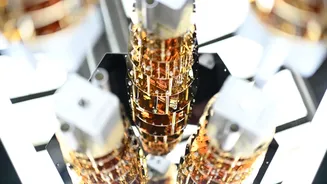
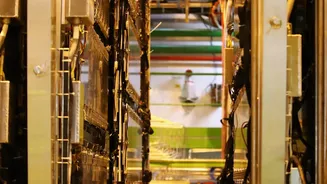
The Large Hadron Collider (LHC) at CERN is the world's most powerful particle accelerator, famous for smashing protons together at nearly the speed of light. While experiments like ATLAS and CMS are designed to find new particles directly, the LHCb experiment takes a different approach. Its name stands for 'Large Hadron Collider beauty', and it specializes in studying the behavior of particles containing a 'beauty' quark (also known as a 'b' quark). These exotic particles are unstable, decaying into lighter particles in a fraction of a second. By precisely measuring these decays in massive numbers, scientists can look for subtle deviations from what's expected. The LHCb detector is a 20-metre-long spectrometer designed to catch the particles thrown forward in the LHC's collisions, where beauty quarks are most likely to be produced. Its goal is to search for indirect evidence of new physics by observing processes that are extremely rare or forbidden by our current theories.
Searching for Cracks in the Standard Model
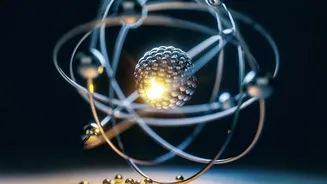
The 'rulebook' for particle physics is known as the Standard Model. Developed over the last half-century, it's a wildly successful theory that describes all the known fundamental particles and three of the four fundamental forces that govern them. However, scientists know it's incomplete. The Standard Model doesn't include gravity, and it offers no explanation for major cosmic mysteries like dark matter or why the universe is made of matter instead of being annihilated by an equal amount of antimatter after the Big Bang. Because of these gaps, physicists are actively searching for 'cracks' in the Standard Model—phenomena that it can't explain. Discovering such a crack would be the first step toward a more complete theory of nature. The LHCb experiment hunts for these cracks by studying rare decays, which are highly sensitive to the influence of undiscovered particles or forces.
The Latest Clue: An Incredibly Rare Decay
In early November 2026, the LHCb collaboration announced a major milestone: they found the first single-experiment evidence for one of the rarest particle decays ever observed. The process involves a particle called a neutral B meson decaying into a pair of muons. According to the Standard Model, this should happen only once in every ten billion decays. After decades of searching, an upgraded LHCb detector, which began operating in 2024, finally captured enough data to see a signal. By combining new data from 2024-2025 with previous runs, the team reached a statistical significance of 3.2 standard deviations (sigma). In particle physics, a 3-sigma result is considered 'evidence', while the gold standard for a 'discovery' is 5 sigma. So, while it's not a confirmed discovery yet, it's a very exciting clue.
Why This Result Matters
The reason physicists call these rare processes 'golden channels' is their sensitivity to physics beyond the Standard Model. The quantum world allows for new, undiscovered particles to pop into and out of existence, subtly influencing how other particles behave. If a new particle or force exists, it could slightly change the rate at which the B meson decays into two muons. So far, the measured rate is consistent with the Standard Model's prediction. However, by making the measurement more and more precise, scientists are narrowing the hiding places for new physics. Even if the results continue to align with the Standard Model, they place powerful constraints on what new theories could be possible. Each new measurement sharpens our picture of the 'zeptoverse'—a realm of incredibly small scales where the next big breakthrough in physics might be found.