


The Old Cosmic Blueprint
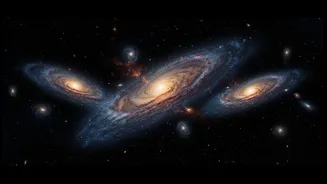
For a long time, the prevailing theory of galaxy formation was a slow, methodical process. Known as the hierarchical model, it painted a picture of small, simple structures gradually crashing into each other over billions of years, slowly building up
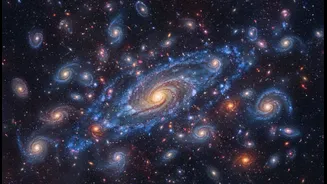
the grand, complex galaxies we see in the nearby universe, like our own Milky Way. Under this model, the first few hundred million years after the Big Bang should have been dominated by small, messy, and disorganized collections of stars. Scientists expected to find that galaxies in this primordial era were just getting started, lacking the structure and chemical richness that comes with age. This was the accepted story, a neat and tidy timeline for cosmic construction.
A New View from the Webb Telescope
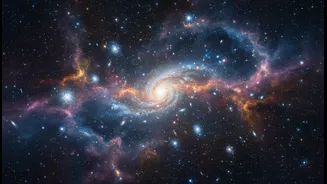
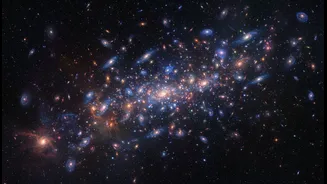
Enter the James Webb Space Telescope (JWST). With its unprecedented power to peer into the infrared spectrum, it can see light that has been travelling for over 13 billion years, offering a direct window into the cosmic dawn. What it's finding there has left astronomers both thrilled and puzzled. Across the board, from galaxies seen just a few hundred million years after the Big Bang to those a billion years out, a consistent theme is emerging: these cosmic toddlers are behaving like teenagers. They are brighter, more numerous, and far more complex than our models predicted. These findings don't break our fundamental understanding of the Big Bang, but they do force a major revision of the astrophysical story that follows.
What Makes a Galaxy ‘Mature’?
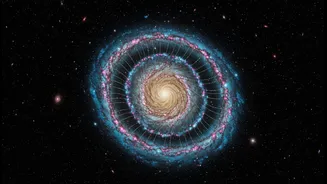
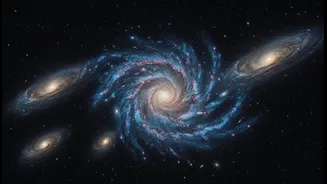
When astronomers talk about a 'mature' galaxy, they are looking for a few key traits. One is chemical enrichment. The early universe was made almost exclusively of hydrogen and helium. Heavier elements, which astronomers call 'metals', are forged inside stars and scattered through space when those stars die. Finding significant amounts of elements like carbon and oxygen in a young galaxy means at least one generation of stars has already lived and died, enriching the environment—a process thought to take time. Another sign of maturity is structure. Young galaxies were expected to be clumpy and chaotic. Instead, JWST is finding galaxies with well-defined features like rotating disks and even stellar bars—long structures that funnel gas to the center—much earlier than anticipated. One study found a galaxy building a complex central disk just 4.5 billion years after the Big Bang, a feature previously seen only in much older systems.
Rewriting the Story of the Stars
These discoveries are forcing scientists to rethink how quickly galaxies can grow. It appears the universe was in a huge hurry to get things built. Several theories are being explored to explain this rapid development. One idea is that star formation was simply far more efficient in the dense, pristine gas of the early cosmos. Another possibility is that the very first stars were much more massive than typical stars today, allowing them to burn through their fuel and enrich their surroundings with heavy elements much faster. Some observations even suggest that supermassive black holes at the centers of these galaxies were actively 'feeding' and growing rapidly, which could have accelerated the entire galaxy's evolution. Whatever the answer, it's clear that our previous models were missing a critical piece of the puzzle.