



The Great Distance Fallacy
In any Indian city, the monsoon rewrites the rules of travel. A journey that is ‘only’ five kilometres away can suddenly take an hour, or even longer. We tend to add a generic 15 or 20-minute buffer to our travel time, assuming it will be enough. This
is the distance fallacy: treating all routes as equal and underestimating the specific, often severe, impact of rainfall on our infrastructure. The reality is that during a downpour, the character of your chosen path matters far more than its length. A shorter route through a low-lying area is a guaranteed trap, while a longer, elevated highway might be surprisingly clear. Relying on distance alone is a recipe for constant tardiness and immense frustration.
More Than Just Rain and Traffic
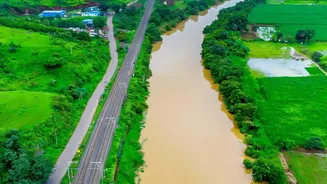
Monsoon travel is not a simple equation of 'rain equals traffic'. The delays are caused by a cascade of route-specific problems. Waterlogging is the most obvious villain. Underpasses, low-lying arterial roads, and areas with poor drainage become impassable choke points. But there's more: potholes hidden under murky water can disable a vehicle, while the constant spray reduces visibility to near zero. In some areas, the risk of falling trees or branches can block entire roads for hours. Marketplaces and commercial hubs, already congested, become chaotic as pedestrians and vendors spill onto narrowed streets. Each of these hazards is tied to a specific location on a route. A road that runs alongside an overflowing drain is fundamentally different from one on higher ground, even if they are parallel.
Become Your Own Route Detective
To truly master monsoon travel, you must think like a detective. Before the season hits, or even after the first few showers, audit your common routes. Which underpass always floods first? Is there a particular stretch of road notorious for gigantic potholes? Where do construction sites create mud baths that slow traffic to a crawl? Use community knowledge. Local social media groups, neighbourhood forums, and even conversations with regular commuters can provide invaluable, real-time intelligence that no app can match. Identify 'red zones' on your mental map—areas to be avoided at all costs after heavy rain—and start mapping out reliable alternative routes, even if they seem longer in distance. This proactive approach transforms your planning from a hopeful guess into a sound strategy.
The Promise and Peril of Technology
Navigation apps like Google Maps and Waze are indispensable tools, offering real-time traffic data that seems perfect for monsoon planning. They can show you red lines of congestion and suggest faster alternatives. However, they have their limitations. Most of these apps rely on crowdsourced data; a road is marked as waterlogged only after several users are already stuck there. They are reactive, not predictive. While some advanced systems are being developed to forecast flooding, they are not yet widely integrated. Therefore, use your apps as a guide, not a gospel. Trust the app's traffic data, but overlay it with your own knowledge of the route's inherent monsoon risks. If the app suggests a shortcut through an area you know floods easily, ignore it. Your local intelligence is the crucial missing piece.
A New Way to Calculate Your Buffer
It's time to abandon the simple '+20 minutes' buffer and adopt a route-quality-based calculation. This requires a mental shift. Instead of a single buffer, create tiers. For a 'Green Route' (well-drained, elevated roads, minimal bottlenecks), perhaps a 1.5x multiplier on the normal travel time is sufficient. For an 'Amber Route' (some known issues, moderate waterlogging risk), a 2x or 2.5x multiplier might be necessary. For a 'Red Route' (passes through multiple low-lying areas, notorious choke points), you might need to triple your estimated travel time, or better yet, avoid it completely. A 20-minute dry-day journey on a Red Route could easily become a 60 to 75-minute ordeal. Building in these route-specific buffers is the key to arriving on time and with your sanity intact.