


The Shared Peril: Mars's Unforgiving Atmosphere
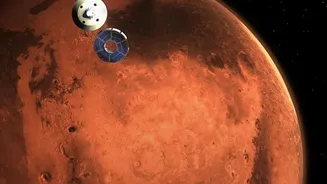
Every mission to Mars, robotic or human, must survive what engineers call Entry, Descent, and Landing (EDL). Often dubbed the 'seven minutes of terror', this is the harrowing phase where a craft screaming through space at over 20,000 km/h must slow to a gentle
stop on the surface. The Martian atmosphere is a major problem: it’s more than 100 times thinner than Earth’s. This makes it a paradox for engineers—it's thick enough to generate catastrophic heat from friction, requiring a heavy heat shield, but far too thin to slow a heavy vehicle down sufficiently with parachutes alone. Every landing to date has been an autonomous, high-stakes ballet of heat shields, parachutes, and last-minute braking systems, because the 4-to-24-minute communication delay means ground control is helpless to intervene.
The Robotic Blueprint: A Well-Honed, Lightweight Craft
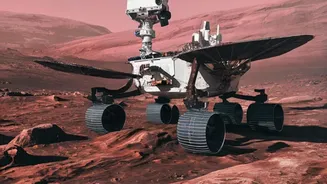
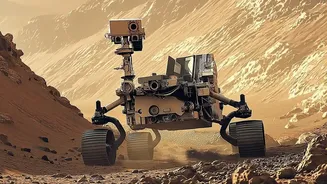
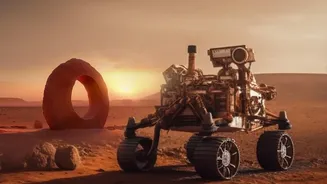
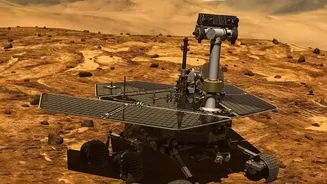
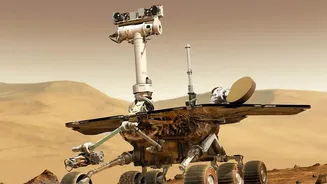
NASA has become remarkably adept at landing robotic explorers on Mars. Missions like the Curiosity and Perseverance rovers, each weighing around one metric ton, represent the pinnacle of this capability. To land them, engineers devised the ingenious 'sky crane' maneuver, where a rocket-powered descent stage hovers above the surface and lowers the rover on cables before flying off to crash a safe distance away. This system works beautifully, but it is pushing the limits of what is possible with this 'Viking-era' technology, which relies on a combination of an aeroshell for initial braking and parachutes for supersonic deceleration. These systems simply do not scale up. A parachute large enough to slow a human-rated vehicle would be too massive and fragile to deploy reliably at supersonic speeds.
The Human Scale: A Problem of Mass
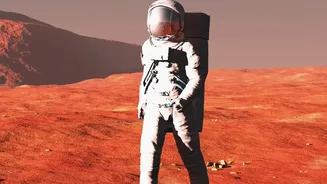
The fundamental difference between robotic and human landings is mass. While Perseverance was a one-tonne payload, a craft carrying humans, their life support, supplies for a long stay, and a return vehicle would weigh 20 to 100 metric tons. Landing a payload 20 times heavier or more is a completely different physics problem. Current landing systems are simply not an option. The sheer momentum of such a heavy object entering the atmosphere means parachutes are almost useless for the primary deceleration. Trying to scale up current methods would be like trying to stop a freight train with a bedsheet. This massive increase in weight is the single biggest hurdle to putting boots on the Martian soil.
The Solution: Supersonic Retropropulsion
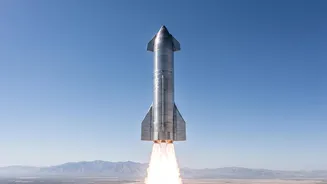
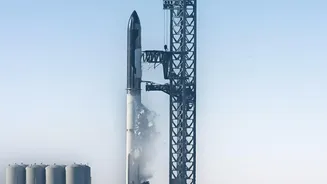
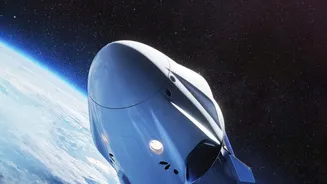
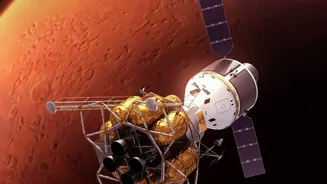
To solve the mass problem, space agencies and private companies like SpaceX are banking on a technology called supersonic retropropulsion (SRP). This involves firing powerful rocket engines against the direction of travel while the vehicle is still moving at supersonic speeds through the thin upper atmosphere. Instead of relying on atmospheric drag and parachutes, the lander would use its own engines to slam on the brakes. Companies like SpaceX are designing their Starship vehicle to perform exactly this maneuver, using its heat shield for initial braking and then firing its powerful Raptor engines to control its descent and land vertically. This technique is essential because it's the only known method that can provide the braking force needed to safely land a vehicle as massive as a human habitat.
Risk, Redundancy, and Precision
Beyond the hardware, the philosophy of risk is profoundly different. Losing a billion-dollar rover is a devastating scientific and financial loss. Losing a human crew would be a global tragedy that could set back space exploration for decades. Consequently, human-rated systems require far more redundancy and much higher safety margins. Landing must also be incredibly precise. While rovers have landing ellipses several kilometers wide, human missions will need to land within meters of pre-positioned assets like habitats, power systems, or resource-gathering equipment. This requires advanced navigation systems that can identify hazards and adjust the landing trajectory in real-time, a capability far beyond what was needed for robotic pathfinders.