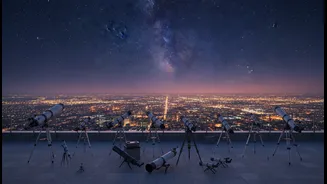










From Concrete Jungles to Cosmic Shores
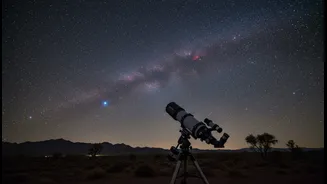
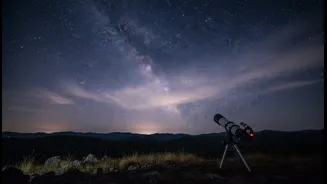
Across India's bustling cities, a growing number of people are transforming their rooftops from simple utility spaces into portals to the universe. After sunset, telescopes large and small are pointed skyward, and neighbours who were once strangers gather
with a shared sense of purpose. This surge in amateur astronomy is fueled by more affordable equipment and a renewed public fascination with space, partly thanks to the successes of India's own space missions. Groups like the Bangalore Astronomical Society and Pune's Jyotirvidya Parisanstha are seeing a boom in interest, with many similar communities sprouting up in cities like Mumbai, Hyderabad, and Delhi. These rooftop gatherings, or 'star parties', have become a modern-day campfire, where the glow of distant galaxies replaces the flicker of flames.
A Glimpse of the Universe's Edge
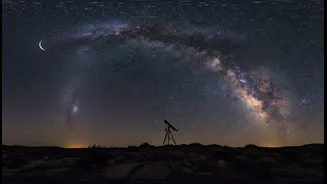
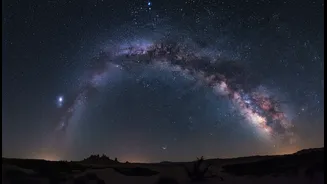
While the headline's 'cosmological horizon formations' is a poetic term, the ambition it represents is very real. The cosmological horizon is the theoretical boundary of our observable universe, the farthest point from which light has had time to reach us. While amateurs cannot directly see this boundary, they can and do observe objects that hint at the universe's immense scale and history. This includes deep-sky objects like the Andromeda Galaxy, our closest major galactic neighbour, and distant nebulae where new stars are born. Some advanced amateurs even contribute to professional science by tracking variable stars, discovering comets, or imaging faint structures around nearby galaxies, providing data that helps scientists understand galactic evolution. Discussing these profound concepts—the age of the universe, the birth of stars, the sheer scale of it all—is a central part of the community experience.
The Telescope as a Modern Campfire
The act of sharing a telescope eyepiece creates a powerful connection. For many urbanites, life can be isolating. Amateur astronomy clubs provide a welcoming space that combats loneliness and fosters a sense of community. The shared experience of witnessing something awesome—a feeling bigger than oneself—helps put daily worries into perspective. Psychologists note that experiencing awe can reduce self-focus and stress, promoting positive emotions. It’s a hobby that bridges generations and backgrounds; the only requirement is curiosity. These clubs often engage in public outreach, setting up telescopes on sidewalks or in parks to share the wonders of the sky with everyone, further strengthening community ties. It's a reminder that we all share the same sky.
Battling the City's Glow
The single greatest challenge for any urban astronomer is light pollution. The perpetual glow from streetlights, buildings, and advertisements creates a 'skyglow' that can wash out all but the Moon and the brightest planets. In many Indian cities, seeing the Milky Way is now a rarity. However, these communities are resourceful. Many use special light-pollution filters that block specific wavelengths of artificial light, allowing the faint light from nebulae and galaxies to shine through. Astrophotographers have developed techniques for taking many short-exposure images and stacking them with software to reveal stunning detail, even from a bright city balcony. For the darkest skies, many groups also organize trips to designated 'dark sky reserves', like the one in Hanle, Ladakh, turning the hobby into an adventurous getaway.