




Thinking While Driving
You can't joystick a rover on Mars in real-time. The communication delay, which ranges from a few minutes to over twenty, makes direct control impossible. This is where autonomous navigation becomes critical. Human engineers on Earth act as mission planners,
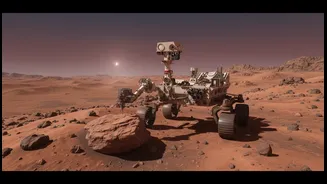
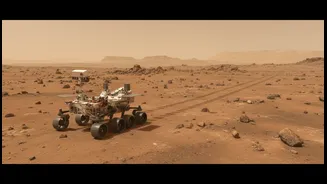
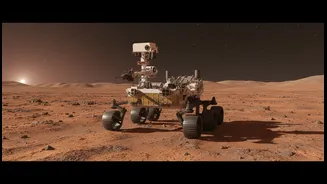
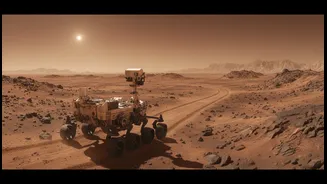
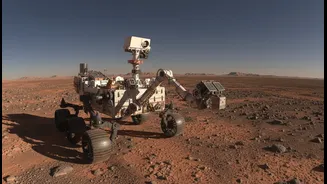
setting a final destination, but the rover itself decides the safest and most efficient way to get there. Systems like NASA's AutoNav, used by the Perseverance rover, essentially allow the vehicle to 'think while driving'. Using a suite of cameras, the rover builds a 3D map of the terrain in front of it, identifies hazards like sharp rocks or steep slopes, and plots a safe path forward, all without pausing for new instructions. This process involves a constant feedback loop between systems that map the terrain, find the safest path by assigning 'cost' scores to different surfaces, and provide a short-range 'reflex' to avoid immediate obstacles. This autonomy has enabled rovers like Perseverance to break speed records, covering more ground for science and spending less time waiting for commands from Earth.
A Long-Distance Conversation
Even with advanced autonomy, rovers still need instructions. Engineers send command sequences that outline the day's tasks, from waking up to driving and conducting experiments. These commands are sent via radio waves, but it's not always a simple direct call. To handle the vast amounts of data, especially high-resolution images, rovers often use a relay system. They transmit data via a UHF antenna to orbiters flying above Mars, which then use their more powerful systems to send the information back to Earth's Deep Space Network. This method is much faster and more efficient than a direct-to-Earth transmission from the rover itself. For smaller packets of information, like daily commands, rovers can use a steerable high-gain antenna to communicate directly with Earth. However, this requires a clear line of sight, which can be blocked by terrain like mountains or canyon walls, forcing mission planners to carefully time when they send commands.
Hardware Built to Last
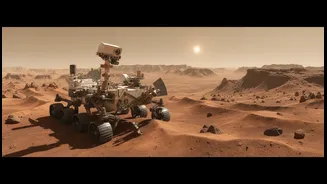
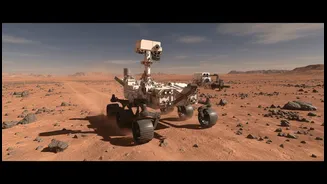
A rover's software is only as good as the hardware it runs on. The Martian surface is an unforgiving environment, and components must be incredibly durable. The wheels are a prime example of this engineering challenge. Curiosity rover's aluminum wheels sustained more wear and tear from sharp rocks than anticipated, leading to punctures and cracks. This provided a critical lesson. For the Perseverance rover, engineers redesigned the wheels to be more robust. They are made of thicker aluminum, have a slightly larger diameter, and feature a different tread pattern with twice as many cleats for better traction and durability. The spokes are made of titanium to provide springy support. This iterative design process, learning from wear on previous missions to improve the next, is fundamental. Beyond wheels, engineers use materials like carbon fiber and other composites that are both lightweight for energy efficiency and strong enough to withstand extreme temperatures and abrasion.
The Art of Managing Risk
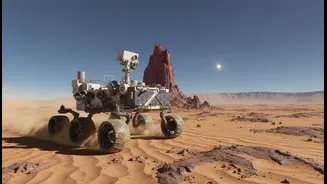
Every decision in a rover mission is an exercise in risk management. This involves a delicate balance between achieving ambitious science goals and ensuring the long-term survival of the vehicle. Engineers use data from the rover's own cameras to assess the route ahead, identifying potentially damaging terrain. When Curiosity's wheels showed unexpected damage, the operations team developed new driving strategies to mitigate wear. These included avoiding driving over hard surfaces with sharp rocks and even driving backward in certain areas to reduce the load on the more damaged front wheels. Route planning algorithms have evolved to incorporate not just the shortest path, but also the path of least risk, taking into account terrain classification and the health of the rover's systems. This strategic approach, combining proactive planning, reactive problem-solving, and continuous learning from wear-and-tear data, is how engineers can keep these robotic explorers operational for years beyond their primary missions.