





The Peril of Lunar Dust
Landing a spacecraft on the Moon is a violent event. Powerful rocket engines kick up clouds of lunar soil, or regolith. Unlike terrestrial dust, which is weathered and smooth, lunar regolith is composed of sharp, abrasive, and electrostatically charged
particles. During a landing, this material is blasted outwards at supersonic speeds, creating a hazard that can sandblast the lander itself, damage nearby equipment like solar panels, and contaminate sensitive instruments. The Apollo missions gave us a firsthand look at this problem; astronauts noted how the dust abraded their spacesuits and caused nasal irritation, highlighting the risk to both hardware and human health. For a future where multiple landers arrive and depart from a single lunar outpost, landing on unprepared ground is simply not a sustainable or safe option.
Enter the Robotic Construction Crew
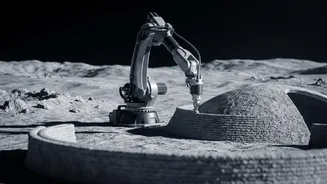
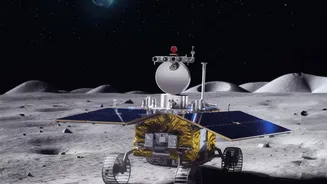
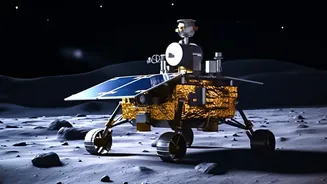
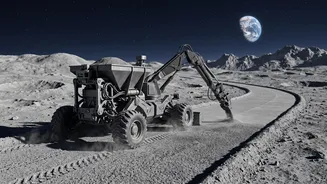
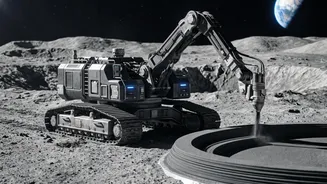
The solution is to build durable, stable landing pads before astronauts arrive. Given the extreme cost of sending materials from Earth—estimated at over a million dollars per kilogram—and the dangers of the lunar environment, the only practical construction crew is a robotic one. Space agencies like NASA and the European Space Agency (ESA) are heavily investing in autonomous construction technologies. The plan involves sending teams of specialized robots that can operate for long periods with minimal human supervision. These robotic teams would perform a sequence of tasks: surveying the site with LiDAR, clearing boulders, grading the surface, and then using the local regolith as the primary building material. This approach, known as In-Situ Resource Utilization (ISRU), is the cornerstone of making off-world settlement economically feasible.
From Dust to Durable Pads
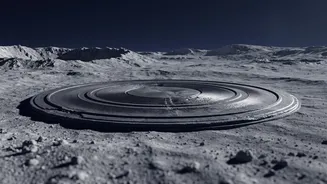
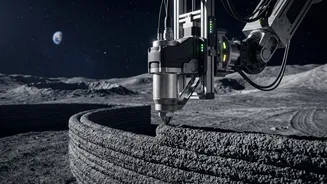
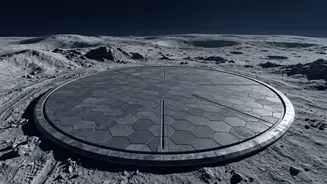
But how do you turn loose soil into a solid structure capable of withstanding rocket exhaust? Researchers are focused on several key methods, primarily centered around sintering or melting the regolith. Sintering involves heating the material to a point where the particles fuse together without fully melting. Powerful microwaves are a leading candidate, as they can heat the regolith efficiently in the vacuum of space. NASA's Project MASON, for example, is developing a rover platform equipped with a microwave emitter to melt regolith into a solid surface. Another promising technique involves using lasers or even concentrated sunlight via large Fresnel lenses to melt the soil into a glassy, solid paver. These methods have been proven in labs using simulated lunar soil, creating bricks with strength comparable to concrete.
The Key Players and Their Projects
Multiple international and commercial entities are pioneering this field. NASA's Moon-to-Mars Planetary Autonomous Construction Technology (MMPACT) project is a major initiative, partnering with companies like ICON to develop technologies for building everything from landing pads to habitats. The ESA has its own program called PAVER (Paving the road for large area sintering of regolith), which has successfully demonstrated using high-powered lasers to create interlocking paver elements from simulated moondust. Beyond government agencies, private companies are also critical. Redwire Space received NASA funding to develop its microwave-based regolith processing technology. Meanwhile, startups like Ethos Space Resources are focused on creating landing pads with embedded navigation beacons to aid precision landings, solving another piece of the puzzle.
Paving the Way to the Stars
The robotic preparation of lunar landing pads is more than just a construction project; it is the foundational layer for our entire future on the Moon and beyond. A single, well-built landing zone allows for a hub of activity, where cargo and crew can arrive safely and repeatedly without endangering existing infrastructure. These prepared surfaces will connect to robotic-built roads, lead to 3D-printed habitats shielded by regolith berms, and support the scientific and commercial activities of a burgeoning lunar economy. The work being done today on autonomous robotic systems and regolith processing is what will transform the Moon from a temporary campsite visited by a few into a permanent, thriving outpost for humanity.