





Earth’s Cautionary Tale
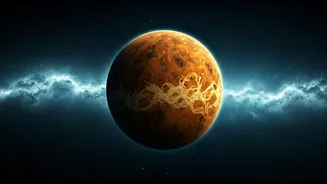
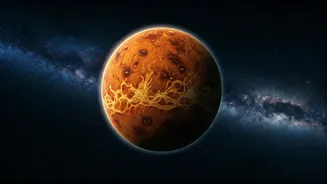
Venus is often called Earth's 'evil twin'. It’s similar in size and structure, but its fate took a drastically different turn. Today, Venus has a crushing carbon dioxide atmosphere, 90 times denser than Earth's, which creates a runaway greenhouse effect,
leading to surface temperatures of around 450°C. Scientists believe, however, that Venus wasn't always this way. Climate models suggest it may have once had a temperate climate, with oceans, rain, and perhaps even continents. Sometime in the last billion years, a cataclysmic climate event, possibly triggered by massive, prolonged volcanic eruptions, pumped enormous amounts of CO2 into the atmosphere. This evaporated the oceans, ended the water cycle, and turned the planet into the inhospitable world we see today. Studying this process isn't just an academic exercise; it's a real-world case study of what happens when a planet’s greenhouse effect spirals out of control.
India’s Mission: Shukrayaan
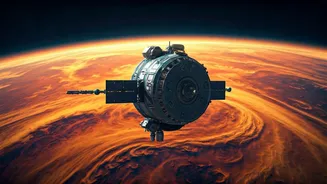
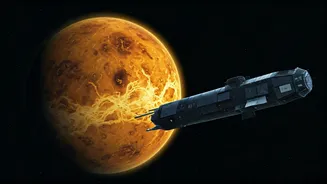
Recognising this crucial link, the Indian Space Research Organisation (ISRO) is spearheading a mission to uncover these secrets. The Government of India has approved the Venus Orbiter Mission (VOM), formerly known as Shukrayaan. Scheduled for a 2028 launch, this will be India’s first mission to Venus and its second interplanetary venture after the successful Mars Orbiter Mission (Mangalyaan). The orbiter is designed to study Venus for over five years, examining its surface, subsurface geology, atmospheric dynamics, and its interaction with the solar wind. This mission places India in a key position within a new wave of global interest in Venus, with NASA and the European Space Agency (ESA) also planning missions around the same timeframe.
What Scientists Hope to Uncover
Indian experts, including teams from institutions like Banaras Hindu University, are already collaborating with international groups to map Venus's geology. The Shukrayaan orbiter will carry a suite of advanced instruments to build on this work. A key payload is a high-resolution Synthetic Aperture Radar (SAR), capable of piercing the planet's thick cloud cover to map the surface in detail. Another is a ground-penetrating radar to explore the subsurface. Together, these instruments will investigate Venus’s geological and volcanic activity, look for emissions from the ground, and analyse its violent weather systems. One of the mission’s key international collaborations includes a Swedish instrument that will study how solar winds interact with and strip away the Venusian atmosphere, a process that may explain how it lost its water.
Bringing the Lessons Back Home
The ultimate goal is to bring the learnings from Venus back to Earth. By understanding the mechanics of Venus's climate collapse, scientists can vastly improve our own climate models. For India, a nation on the front lines of climate change, this is particularly urgent. The data can help refine predictions about monsoon behaviour, the frequency of extreme weather events, and the long-term impacts of rising greenhouse gas concentrations. While there is no danger of Earth becoming exactly like Venus, the processes are governed by the same laws of physics. Studying a planet where those processes have reached their most extreme conclusion provides invaluable data points for securing our own planet’s future. The Venus mission is more than just space exploration; it’s an investment in Earth’s climate resilience.