





Looking for a high-intensity workout you can do anywhere, with no equipment? Shadow boxing is a powerful, engaging, and effective way to build fitness, burn calories, and sharpen your mind, all without ever stepping into a ring.
What Exactly Is Shadow Boxing?
At its core, shadow boxing
is the art of practicing boxing movements against an imaginary opponent. It’s a foundational training method used by professional fighters and fitness enthusiasts alike. Instead of hitting a heavy bag or a person, you focus entirely on your own form, movement, and technique. This makes it the perfect entry point for beginners, as it removes the pressure of impact and allows you to build a solid base of skills at your own pace. You’re not just waving your arms; you’re performing a coordinated, full-body exercise that combines cardio, strength, and mental focus.
The Full-Body Fitness Benefits
Shadow boxing is far more than just a warm-up. A consistent routine delivers a surprising range of fitness benefits. It serves as excellent cardiovascular conditioning, getting your heart rate up and improving endurance. The constant motion and combination of punches, footwork, and defensive moves engage your entire body, activating your core, hips, shoulders, and legs with every sequence. This improves coordination, balance, and body awareness as you learn to move with intent. Plus, many find it to be a fantastic stress reliever, offering a way to channel energy and focus your mind.
Finding Your Stance
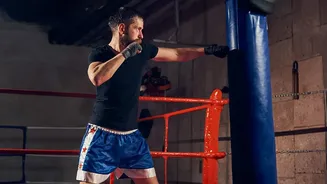
Everything in boxing starts from the ground up. Before you throw a single punch, get your stance right. If you’re right-handed, you’ll use an 'orthodox' stance. Stand with your feet about shoulder-width apart, then step your left foot forward. Your lead foot should point roughly towards your imaginary target, while your back foot is angled slightly outward for stability. Keep a slight bend in your knees and your weight evenly distributed on the balls of your feet, never flat-footed. Bring your fists up to your cheekbones to protect your face, keeping your elbows tucked in close to your ribs. Your chin should be slightly down. This is your home base.
Mastering the Four Core Punches
For a beginner, mastering four key punches is the goal. Focus on form over power. 1. The Jab: This is a quick, straight punch with your lead (front) hand. Snap it out and bring it straight back to your guard position. It's for speed and setting up other punches, not for knockout power. 2. The Cross: This is your power punch, thrown with your rear hand. As you punch, pivot on your back foot and rotate your hips to generate force. It should travel in a straight line. 3. The Lead Hook: A semi-circular punch with your lead arm bent at roughly a 90-degree angle. The power comes from rotating your hips and torso, not from swinging your arm. 4. The Uppercut: A short, rising punch. Slightly dip your knees and drive the punch upward from your hips, as if aiming for your opponent's chin.
Putting It All Together: A Beginner Workout
A simple and effective way to start is with timed rounds, just like in a real boxing gym. Use your phone's timer. Aim for 2nd minute rounds with 1 minute of rest in between.
Warmup (3rd minute): Start with light cardio like jumping jacks, arm circles, and torso twists to get your muscles ready.
Round 1 : Footwork and Jabs . Move around your space in your boxing stance . Practice stepping forward , backward , and side -to -side . Throw only single and double jabs . Focus on bringing your hand back to your guard every time.
Round 2 : Jab - Cross (1 -2) . Stay light on your feet . Throw jab - cross combinations . After each combo , move . Step , pivot , or circle away . Focus on rotating your hip with every cross.
Round 3 : Add the Hook (1 -2 -3) . Now , add a lead hook after your jab - cross . The sequence is jab , cross , lead hook . Keep your elbow high on the hook . Move after every combination.
Cool -down (3 minutes): Walk around and let your heart rate come down. Gently stretch your shoulders, chest, and legs.
Common Mistakes to Avoid
As you get started, watch out for a few common pitfalls. Many beginners plant their feet and forget to move; footwork is just as important as the punches. Another mistake is dropping your nonstretching hand instead of keeping it up to guard your face. Avoid the temptation to only focus on offense. Imagine an opponent and practice defensive moves like slips (moving your head off the centerline) and rolls (ducking under an imaginary punch). Finally, remember to breathe! Exhale sharply with every punch you throw. Holding your breath will make you tense and tire you out quickly.