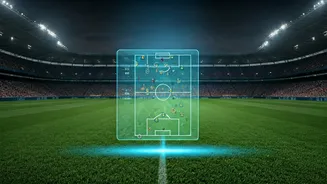









The Inverted Winger Problem
First, let's understand the core challenge. Mahrez is a left-footed player who operates almost exclusively from the right wing. This makes him an 'inverted winger', a role designed to be devastatingly effective in modern football. His entire game is built
around receiving the ball wide, drawing in the defender, and then cutting inside onto his magical left foot. From there, he can curl a shot towards the far post, thread a killer pass through the defense, or combine with teammates in tight spaces. A conventional plan to simply 'show him down the line' isn't enough, as he has improved his ability to go on the outside and cross with his right foot. The plan to stop him has to be more sophisticated.
A Disciplined Full-Back and Winger Duo
The first line of defense will be Switzerland’s left-back, likely the veteran Ricardo Rodríguez. He cannot afford to get drawn in too easily. Mahrez thrives in 1-v-1 situations, using his incredible close control and flurry of stepovers to unbalance defenders. Rodríguez needs support. The Swiss winger ahead of him, perhaps Ruben Vargas, must be incredibly disciplined in tracking back. This creates a 2-v-1 situation, forcing Mahrez to either release the ball early or attempt a high-risk dribble. Coach Murat Yakin's system, which often prioritizes defensive organization and frustrating opponents, provides a strong foundation for this collective responsibility.
Crowd the Half-Space
The most dangerous area Mahrez operates in is the 'half-space' – the channel between the opponent's full-back and centre-back. When he cuts inside, this is his destination. This is where Switzerland's midfield, anchored by the indispensable Granit Xhaka, comes in. Xhaka, or another central midfielder like Remo Freuler, must be tasked with shuttling across to close this channel the moment Mahrez makes his move. The goal is to deny him time and space to get his head up. If he receives the ball and is immediately met with pressure from both the side (full-back) and the center (midfielder), his options are drastically reduced. Yakin's flexible 4-3-3 or 3-4-2-1 formations allow for this kind of midfield density.
No Cheap Fouls
While physicality is necessary to disrupt a rhythm player like Mahrez, it must be intelligent. He is exceptional at drawing fouls in dangerous areas. Giving away free-kicks on the edge of the penalty box is inviting disaster, as he can be lethal from set-pieces. Swiss defenders, including the formidable Manuel Akanji, must remain on their feet, using their body positioning to block his path rather than lunging into reckless challenges. The aim is to frustrate him and force him into errors, not to give him free opportunities on goal.
The Best Defense is a Good Offense
Finally, a purely defensive strategy will likely fail. Switzerland must ask questions of Mahrez himself. For Algeria, Mahrez is often the system, granted freedom without extensive defensive responsibilities. Switzerland can exploit this. By launching quick attacks down their left flank, they can force Mahrez to track back and defend, pinning him deep in his own half. An overlapping run from Rodríguez or a direct, pacey run from the left-winger could make Mahrez reluctant to stray too far forward. This not only limits his attacking output but can also drain his energy over the course of 90 minutes.