








The Foundation: Visual Development Engines
First, let's break down the initial component: visual app development engines. Often known as low-code or no-code platforms, these tools have fundamentally changed who can build software. Instead of requiring developers to write thousands of lines of complex
code, these platforms offer a visual, drag-and-drop interface. Think of it like building with digital LEGO blocks. Users can assemble applications by connecting pre-built components, designing user interfaces, and defining logic through graphical workflows. This approach democratizes development, allowing business analysts, department heads, and entrepreneurs—so-called "citizen developers"—to build functional applications without deep programming expertise. The primary advantage here is a significant reduction in the time and technical skill needed to create a functional product from scratch.
The Accelerator: Integrated AI Assistants
Now, imagine giving that visual engine a super-intelligent co-pilot. That's the role of the AI assistant. These are not just simple chatbots; they are generative AI tools deeply integrated into the development environment. They function as active partners, capable of understanding natural language commands. A user can simply describe what they need—"Create a user registration form with fields for name, email, and password," or "Build a workflow to approve expense reports"—and the AI translates those instructions into functional components. This AI can generate code snippets, suggest database structures, and even help debug issues, acting as an on-demand developer. This layer of intelligence automates many of the most time-consuming parts of the development process, from initial logic creation to optimization.
The Synergy: From Idea to Testable Product in Record Time
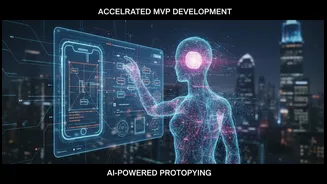
The exponential acceleration happens when these two technologies work in concert. A product manager can now sketch out an idea, use the visual engine to build the basic framework, and then direct the AI assistant to flesh out the complex parts. For example, the AI can generate entire user interfaces from a simple text prompt or even a uploaded image of a sketch. It can automate the creation of test cases and even run them, drastically shortening the quality assurance cycle that often bogs down MVP schedules. Instead of a developer manually coding a feature, a business user can describe it to the AI, which then builds it within the visual platform. This seamless workflow reduces the development timeline from months to weeks, and in some cases, even days. The cycle of building, measuring, and learning that is core to the MVP process becomes incredibly rapid.
Beyond Code: Intelligent Automation and Data Handling
The acceleration isn't just about writing code faster. AI assistants integrated into these platforms also supercharge data handling and process automation. They can help build intelligent workflows that make decisions based on data, automate routing of tasks, and even provide predictive analytics without a data science team. For an MVP, this means you can test not just the app's features but also its underlying business logic and intelligence from day one. AI can help clean and organize data for the MVP, generate realistic sample data for testing, and even analyze early user feedback to identify crucial patterns and suggest the next set of features to build. This reduces guesswork and ensures the product evolves based on real insights.
The Impact on Innovation and Business
This combination represents a paradigm shift for innovation, particularly within India's dynamic startup ecosystem where agility is paramount. The ability to build and test ideas at a fraction of the traditional cost and time lowers the barrier to entry for new entrepreneurs. It allows larger companies to experiment more freely, fostering a culture of innovation without the massive resource commitment previously required. Teams can validate product-market fit before competitors have even finished their initial planning. This isn't just an incremental improvement; it's a fundamental change in how quickly a business can respond to market needs, pivot based on feedback, and ultimately, find a path to success. The focus shifts from the challenge of building to the opportunity of learning from users.