






The Ultimate Safety Net
The Crew Escape System (CES) is a critical safety feature designed for one purpose: to save the lives of astronauts if a catastrophic failure occurs during the launch of the Gaganyaan mission. Think of it as a highly advanced ejection seat, but instead
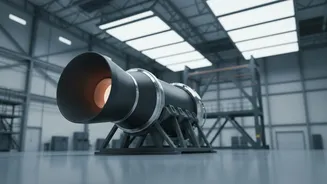
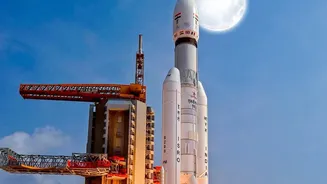
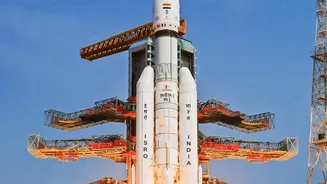
of ejecting a single pilot, it pulls the entire crew capsule away from the malfunctioning rocket. Positioned at the very top of the Human-rated Launch Vehicle Mark-3 (HLVM3) rocket, the CES is equipped with a set of powerful, quick-acting solid motors. These aren't ordinary rocket motors; they are engineered to fire with immense force, generating acceleration far greater than the launch vehicle itself to ensure a rapid and safe separation.
Detecting Danger in Milliseconds
During a launch, there is no time for human intervention to decide on an abort. The decision is made autonomously by the Integrated Vehicle Health Management system (IVHM). This sophisticated network of sensors constantly monitors thousands of parameters, from engine performance to structural integrity. If the IVHM detects a critical anomaly that could jeopardize the mission and the crew, it automatically triggers the abort sequence in milliseconds. This system is designed to act decisively, whether the emergency happens on the launch pad or, more complexly, during the high-speed ascent through the atmosphere.
The High-Altitude Abort Sequence
A high-altitude abort presents unique challenges due to the rocket's high velocity and the thinning atmosphere. The successful Test Vehicle Abort Mission-1 (TV-D1) in October 2023 demonstrated exactly how this works. In such a scenario, the abort is triggered while the rocket is travelling faster than the speed of sound. The CES motors ignite, pulling the Crew Module away from the launch vehicle with tremendous force. Once at a safe distance and altitude, the escape system jettisons itself from the Crew Module. The module then begins its descent, but it's still moving too fast for a safe landing.
From Freefall to Splashdown
After separation, a meticulously timed sequence of parachutes takes over. First, smaller drogue parachutes are deployed at high altitude to stabilize the capsule and slow it down from supersonic speeds. This initial deceleration is crucial for ensuring the main parachutes can deploy without being shredded by the extreme forces. Once the module has slowed sufficiently and reached a lower altitude, the main parachutes are released. These large canopies gently lower the capsule for a soft splashdown in the sea. The entire sequence, from abort initiation to parachute deployment, is executed autonomously to ensure the crew is brought back to Earth safely.
Proven Through Rigorous Testing
The functionality of the CES is not just theoretical. ISRO has conducted a series of rigorous tests to validate every aspect of the system. This includes the Pad Abort Test in 2018, which simulated an emergency on the launch pad, and the crucial TV-D1 mission, which proved the system's effectiveness in a high-altitude, in-flight abort scenario. The TV-D1 test successfully simulated an abort at an altitude of about 17 km, validating the performance of the escape motors, the separation sequence, and the parachute system. Data from hundreds of sensors confirmed that every component performed as intended, marking a major milestone for the Gaganyaan programme and a significant step forward for crew safety.