




The Lure of Lunar Water
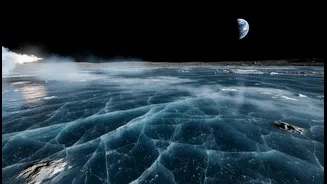
For decades, the Moon was seen as a bone-dry desert. Now we know better. Orbiters have detected strong evidence of water ice tucked away in permanently shadowed craters at the lunar poles, where temperatures are cold enough to have preserved it for billions
of years. This ice is more than a scientific curiosity; it's a game-changing resource. Future astronauts could potentially convert it into drinking water, breathable oxygen, and, most importantly, rocket fuel. The ability to 'live off the land' by harvesting this ice is a cornerstone of making long-term human settlement on the Moon and future missions to Mars a sustainable reality. This ancient ice also holds invaluable clues about the early solar system and the origin of water on Earth.
An Unavoidable Side Effect
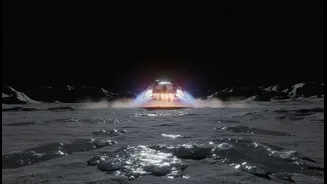
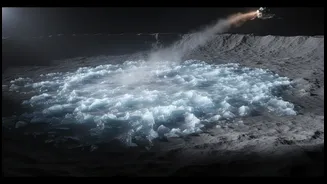
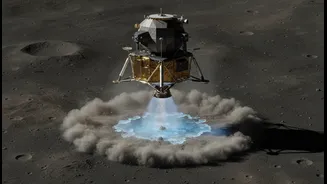
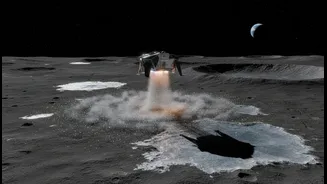
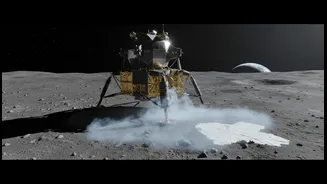
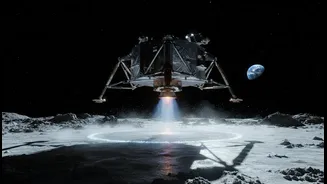
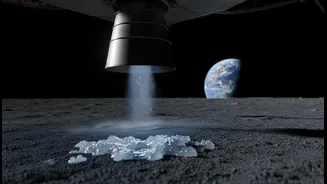
Here's the problem: you can't land gently on the Moon without powerful rocket engines. During the final moments of descent, a lander’s thrusters blast the surface with supersonic jets of hot gas. On an airless body like the Moon, this exhaust plume expands dramatically, kicking up lunar dust and scouring the surface. But it also releases its own chemical cocktail. The propellants used in many lander engines produce significant amounts of water vapor and other chemicals like methane when they burn. In the Moon's near-vacuum, these exhaust molecules can travel vast distances, effectively creating a temporary, artificial atmosphere that spreads across the entire lunar surface.
Modeling a Global Contamination Event
Scientists have known about this issue since the Apollo era, but the focus on polar ice has given it new urgency. Using powerful supercomputers, researchers have created sophisticated models to predict how these exhaust plumes behave. The results are concerning. Simulations show that exhaust from a single lander near the south pole can spread globally in a matter of hours. A significant portion of the water vapor and other chemicals can persist for months before eventually freezing out and settling in the same cold, dark craters that hold the native ice. One study even found that exhaust from some planned large landers could deposit more water into these regions than was delivered by the Apollo missions combined.
The Need for Mission-Specific Data
The core of the issue, as the headline suggests, is that these are still just models. While incredibly useful, they are based on assumptions about how the gas interacts with the unique lunar soil, or regolith. Different lander sizes, engine configurations, and landing zone soil properties can all change the outcome dramatically. The models predict a problem, but to truly understand the risk, scientists need real-world data—a process called validation. Without it, there's a serious danger of contaminating the very thing we are going to study. Future missions could struggle to distinguish between the lander's exhaust and the billion-year-old ice they came to find, potentially jeopardizing the immense scientific investment.
A Race for Ground Truth
Recognizing this gap, NASA and other space agencies are working to get the crucial 'ground truth' data needed to refine their models. At facilities like NASA's Langley Research Center, engineers are conducting complex tests in massive vacuum chambers, firing rocket nozzles at simulated lunar soil to directly measure the effects. These experiments help validate and improve the computational models, making their predictions more reliable. Furthermore, the first wave of commercial and international landers heading to the Moon under programs like Artemis will be equipped with instruments specifically designed to measure the impact of their own landings. This data will be critical for planning future science missions and ensuring the long-term integrity of lunar exploration.