






Priority: Perfect Recall and Verbatim Records
If your primary need is a perfect, word-for-word account of a meeting, AI tools are unmatched. Platforms like Otter.ai, Fireflies.ai, and DingTalk provide real-time transcription, capturing every detail without human error or fatigue. This is invaluable
for legal discussions, compliance meetings, or detailed technical sessions where precise phrasing matters. These tools create a searchable, shareable archive, eliminating disputes over who said what. An AI-generated transcript serves as a single source of truth, ensuring that no action item or decision gets lost in translation. For organizations focused on documentation and accountability, the verbatim record created by AI offers unparalleled peace of mind.
Priority: Deep Comprehension and Active Engagement
When the goal is to truly understand and process complex ideas, handwriting has a distinct cognitive advantage. Research consistently shows that the act of writing by hand activates more areas of the brain involved in learning and memory than typing. The slower pace forces you to synthesize and rephrase information rather than just transcribing it. This process, known as 'encoding', helps cement concepts in your mind, leading to better recall and a deeper understanding of the material. Unlike passively listening while an AI records, manual note-taking keeps you actively engaged in the conversation, helping you identify nuances, context, and unspoken cues that a transcript might miss.
Priority: Speed, Efficiency, and Scalability
In a fast-paced environment, the efficiency of AI is a game-changer. AI meeting tools don't just transcribe; they summarize key points, extract action items, and identify speakers automatically. A task that might take a person hours—cleaning up notes, assigning tasks, and sending out a recap—is done by AI in minutes. This dramatically reduces the administrative overhead that follows meetings, freeing up teams to focus on execution rather than documentation. Furthermore, AI is infinitely scalable. It can 'attend' and process multiple meetings simultaneously without a drop in performance, a feat no human can match. For teams looking to maximize productivity, AI offers a clear path to getting more done.
Priority: Creative Brainstorming and Conceptual Thinking
Handwritten notes are not just for linear information capture; they are a canvas for thought. When your priority is brainstorming or mapping out a complex concept, the freedom of a pen and paper is superior. You can draw diagrams, create mind maps, and connect ideas in a non-linear fashion that reflects the natural flow of creative thought. This physical act of organizing ideas visually can inspire new connections and insights that a structured, text-based AI summary would never produce. Handwriting allows your thoughts to flow freely, making it the ideal tool for early-stage ideation, strategic planning, and any task that values flexibility over rigid structure.
Finding a Hybrid Approach: The Best of Both Worlds
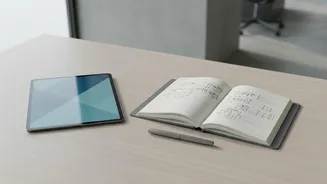
Ultimately, the choice between AI and handwriting isn't a strict binary. The most productive professionals often use a hybrid approach. Let an AI tool handle the heavy lifting of creating a complete, searchable transcript. This provides a safety net, ensuring no detail is ever truly lost. Meanwhile, you can use a notebook to take handwritten notes focused on your own priorities: key takeaways, personal action items, questions that arise, and conceptual diagrams. This method allows you to stay actively engaged and benefit from the cognitive advantages of handwriting, while still having a flawless digital record to refer back to. By combining the two, you leverage the AI for its perfect recall and the pen for its ability to deepen your own thinking.