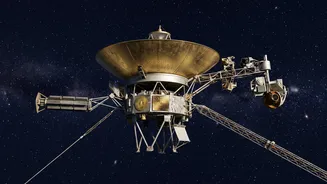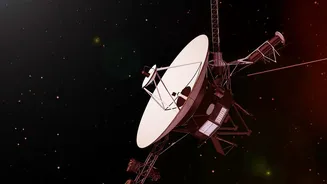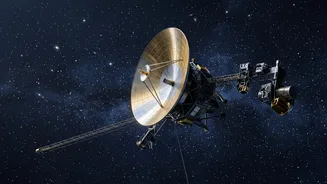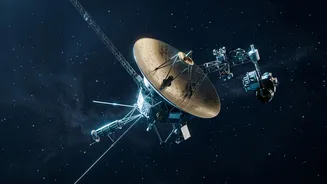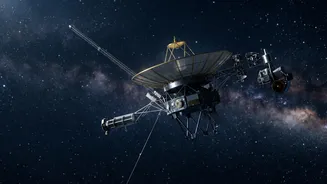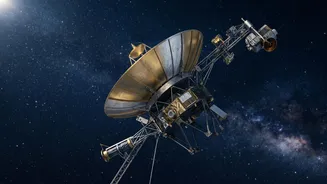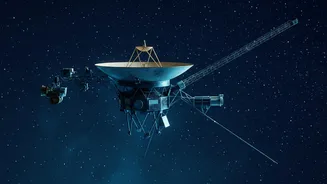



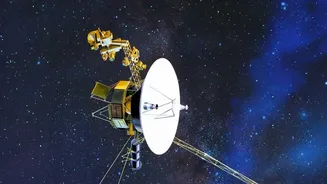
Nearly 26 billion kilometres from Earth, a 49-year-old spacecraft just gave its creators a ghostly surprise. After a brief, worrying silence, NASA's Voyager 1 probe started talking again — without any help from home.
A Ghost in the Machine
In mid-October 2026, NASA's Deep Space
Network missed two scheduled check-ins with Voyager 1. For about 48 hours, the line was dead. Mission managers at the Jet Propulsion Laboratory (JPL) began preparing to diagnose the problem, a process complicated by the immense distance. A command sent from Earth now takes nearly a full day to reach the probe, and another day for a response to return. But before the team could intervene, Voyager 1's signal reappeared on October 20. The spacecraft had, in essence, fixed itself. Engineers determined that the probe’s onboard fault-protection systems had automatically detected an issue with a group of thrusters, switched to a backup set, and re-established contact, all on its own. 'This is the first time we've seen the spacecraft do something like this', said Kareem Badaruddin, the Voyager mission manager at JPL.
The Long Road to Interstellar Space
Launched in 1977 with an initial five-year mission to study Jupiter and Saturn, Voyager 1 and its twin, Voyager 2, have become humanity's longest-running and most distant space mission. After a 'Grand Tour' of the outer planets that revolutionised our understanding of the solar system, Voyager 1 kept going. In 2012, it became the first human-made object to enter interstellar space, crossing the boundary where the Sun's influence gives way to the vast expanse between stars. For the last decade, it has been our only direct source of data from this unexplored region. This resilience is what makes the latest 'self-repair' so remarkable. For a piece of technology nearly half a century old, operating in the frigid vacuum of space, such an autonomous recovery is an unexpected and welcome gift for the science community.
A Race Against Fading Power
The latest communications glitch is not the only challenge. The central issue for Voyager 1 is its dwindling power supply. The probe runs on radioisotope thermoelectric generators (RTGs), which convert the heat from decaying plutonium into electricity. This power source has been incredibly reliable, but its output drops by about four watts every year. With power margins now razor-thin, NASA engineers have been forced to make difficult choices, shutting down instruments to conserve energy for the most critical systems. Just recently, in September 2026, engineers executed a clever power-saving maneuver nicknamed the 'Big Bang'. They simultaneously swapped three older, more power-hungry warming devices for lower-power alternatives, a delicate operation that extended the life of the remaining science instruments and may have delayed the next instrument shutdown until at least 2027.
What It's Still Telling Us
Despite the power saving measures, which have seen instruments turned off over the years, Voyager 1 is still doing science. As of late 2026, two instruments remain operational: the Plasma Wave Subsystem, which measures plasma waves, and the Magnetometer, which studies magnetic fields. Data from these instruments is crucial for understanding the interstellar medium — the mix of particles, dust, and magnetic fields that fill the space between stars. The recent thruster swap did not interrupt this data flow, which continues to stream back to Earth, painting a picture of a region humanity has only just begun to explore. The information provides a unique, in situ look at the environment outside our solar bubble, something no other spacecraft can currently provide.
An Approaching Milestone
As if to celebrate its own resilience, Voyager 1 is about to reach another historic milestone. On November 18, 2026, it will be one light day from Earth. This means a radio signal, traveling at the speed of light, will take a full $ २४$ hours to make the one way trip. It is a profound demonstration of the crafts immense distance — about $ १६٫१$ billion miles ($ २५٫९$ billion kilometers) from home. As Suzanne Dodd, Voyagers project manager noted,'If you want to say hello to Voyager,' you send your message and then you go home and you wait two days before you finally get a response'.