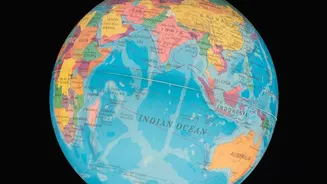









India, a nation stretching nearly 3,000 kilometres from east to west, runs on a single clock. This means the sun rises almost two hours earlier in Arunachal Pradesh than it does in Gujarat, a discrepancy with significant daily consequences.
A Legacy of Colonial Unification
The origin
of Indian Standard Time (IST) is rooted in the British colonial era. Before 1906, major cities like Calcutta and Bombay had their own local times. However, the expansion of the railway network created a need for a unified time to prevent confusion and accidents. In 1905, the British administration established IST, setting it five and a half hours ahead of Greenwich Mean Time (GMT). This was based on a longitude passing just east of Mirzapur in Uttar Pradesh, chosen as a central line for the subcontinent. After independence in 1947, the new Indian government adopted IST as the official time for the entire country, seeing it as a symbol of national unity. While cities like Calcutta and Bombay resisted for a few more years, the single time zone eventually became the standard.
The Sun Rises, but the Day Waits
The geographical reality of India's vastness clashes with its single time zone. Spanning about 30 degrees of longitude, there is a natural time difference of nearly two hours between its easternmost and westernmost points. For residents of Northeast India, this creates a significant disconnect between daylight and daily schedules. In states like Arunachal Pradesh, the sun can rise as early as 4 a.m. in summer. However, with government offices and schools opening at 10 a.m., several hours of productive daylight are lost. Conversely, the sun sets as early as 4 p.m. in winter, forcing people to rely on artificial lighting for the remainder of their work and evening activities. This leads to higher electricity consumption and is believed to impact productivity and overall well-being.
An Unofficial Solution: 'Chai Bagaan Time'
In response to the daylight mismatch, an informal system has long existed in Assam's tea gardens: 'Chai Bagaan Time' or 'tea garden time'. Introduced by British planters over a century ago, this practice involves setting clocks one hour ahead of IST. This allows garden workers to start their day earlier, making better use of the morning sun and aligning their work schedules more closely with the natural rhythm of the day. The practice is not officially sanctioned but is a practical adaptation that highlights the challenges of a single time zone. It is often cited by those advocating for a separate, official time zone for the Northeast.
The Scientific Case for Two Time Zones
The debate over multiple time zones is not just anecdotal. India's official timekeeper, the Council of Scientific & Industrial Research's National Physical Laboratory (CSIR-NPL), has proposed creating two time zones. The proposal suggests an IST-I (UTC +5:30) for most of the country and an IST-II (UTC +6:30) for the northeastern states, including Assam, Meghalaya, Nagaland, and others. The proposed dividing line would be the narrow border between West Bengal and Assam. Researchers argue this could save a significant amount of energy annually and improve human productivity by better aligning work hours with people's natural biological clocks, or circadian rhythms.
Why the Government Remains Hesitant
Despite the scientific backing and persistent demands from northeastern states, the central government has consistently rejected the idea of multiple time zones. The primary concerns are logistical and political. Officials have cited the potential for chaos in railway scheduling, as trains would have to adjust times when crossing zones. There are also fears that introducing a separate time zone could foster a sense of separation and division, undermining national unity. These 'strategic reasons' have been the government's consistent justification for maintaining the status quo, even as recently as late 2026, when new rules were drafted to legally mandate the exclusive use of IST for all official and commercial purposes. For now, it seems India will continue to operate as one nation under one clock.