





First, A Quick Reality Check
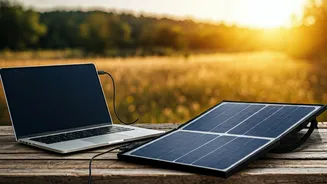
Before you imagine plugging your laptop directly into a sleek, foldable solar panel and working under the sun, it’s important to understand how the system actually works. Direct charging from a panel to a laptop is generally not recommended. Solar energy
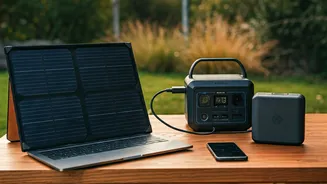
generation is inconsistent; a passing cloud or a change in the sun's angle can cause the power output to dip, potentially confusing your laptop's charging circuit or even causing damage over time. The solution is a three-part system: the solar panel (to capture energy), a power bank or portable power station (to store and regulate that energy), and your laptop. The panel charges the power bank, and the power bank provides a stable, consistent charge to your laptop. This setup is safer, more reliable, and lets you charge your devices even after the sun has set.
Know Your Laptop's Power Needs
The single most important factor in choosing a solar setup is knowing how much power your laptop consumes. You can find this information on the brick-like AC adapter that came with your computer. Look for the 'Output' specification. You'll see numbers for volts (V) and amps (A). To find the wattage (W), simply multiply these two numbers (Volts x Amps = Watts). For example, a MacBook Air adapter might be rated at 20V and 2.25A, meaning it requires 45W. A more powerful Dell XPS or a gaming laptop might need 90W, 130W, or even more. This wattage number is your target. Your power bank must be able to output at least this much power, and your solar panel must be able to generate enough energy to refill that power bank in a reasonable amount of time.
The Power Bank Is Your Workhorse
Think of the power bank as the heart of your off-grid setup. For modern laptops, you’ll need one that supports USB-C Power Delivery (PD). This technology allows for higher power transfer than standard USB ports. When shopping for a power bank, check for two key specs: its capacity, measured in milliamp-hours (mAh), and its maximum power output, measured in watts (W). For laptop charging, look for a capacity of at least 20,000mAh, which can typically provide one full charge for a standard ultrabook. More importantly, ensure its maximum output matches or exceeds your laptop's requirement. If your laptop needs 60W, a power bank that only outputs 30W will charge it very slowly, or not at all while you're using it. A power bank with a 60W or 100W PD output port is a great starting point for most laptop users.
Choosing the Right Solar Panel
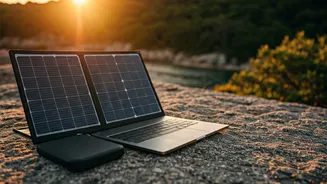
Now for the panel itself. The advertised wattage of a solar panel (e.g., 60W, 100W) represents its output under ideal, laboratory conditions—direct, bright sunlight on a cool day. In the real world, you should expect to get about 70-80% of that rated power at best. A good rule of thumb is to choose a panel with a wattage rating that is at least 1.5 times the output of your power bank's charging port. For example, if you want to effectively charge a power bank that accepts a 60W input, a 100W solar panel is a solid choice. This gives you a buffer for less-than-perfect conditions. A smaller 30W panel would technically work, but it would take a very long time to fill a large power bank. For lightweight travel, foldable panels made with high-efficiency monocrystalline cells offer the best balance of power, weight, and packability.
Putting It All Together: An Example
Let's make this practical. Say you have a standard ultrabook that requires 45W to charge. Here is a balanced, effective setup: 1. **Laptop:** Requires 45W of power. 2. **Power Bank:** Choose one with at least 20,000mAh capacity and a USB-C PD port that can output 45W or more (a 60W output port is a common and safe bet). 3. **Solar Panel:** To charge that power bank effectively, a foldable 80W or 100W panel would be ideal. This size ensures you can capture meaningful power even on partly cloudy days or when the sun isn't at a perfect angle. With this system, you can use the panel to top up your power bank during peak sunlight hours. Then, you can use the power bank to charge your laptop whenever you need it, day or night, ensuring you always have a stable and reliable power source.