


1. A Veteran Landmark vs. a New Arrival
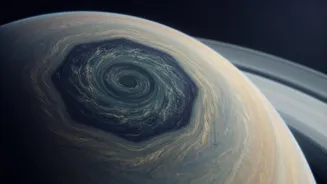
The most striking difference is their age and persistence. The northern hexagon is an old, stable landmark. It was first spotted by the Voyager spacecraft in the early 1980s and has been observed consistently ever since by probes like Cassini and the Hubble
Space Telescope. It has remained for more than 40 years, a fixture of the planet's atmosphere. In contrast, the southern decagon is a newcomer. NASA's Cassini spacecraft, which orbited Saturn from 2004 to 2017, saw no such persistent geometric shape at the south pole, only a massive, hurricane-like vortex. The decagon appears to have formed sometime after 2017, with the first hints appearing in 2023 and becoming more defined by 2025. This gives scientists a rare chance to watch a massive planetary weather pattern develop in near real-time.
2. Geometry: Six Sides vs. Ten
The most obvious point of contrast is their shape. The northern feature is a remarkably precise six-sided jet stream, with each side being longer than the diameter of Earth. It’s a true hexagon. The southern feature, as its name suggests, is a ten-sided atmospheric wave. While both are polygons, the southern decagon is larger, measuring about 104,250 miles wide. Unlike the rigid and stable hexagon, the decagon appears more fluid; its vertices shift back and forth over a cycle of about 32 days, suggesting it's a meandering wave rather than a fixed structure. This difference in the number of sides has scientists questioning why nature would prefer six sides at one pole and ten at the other.
3. Stability: Unwavering vs. Evolving
Saturn's northern hexagon is famous for its stability. It rotates with the planet and doesn't shift its position, behaving like a fixed feature despite being made of flowing gas. It has survived decades of seasonal changes, and while its color has shifted from blue to gold with increased sunlight, its shape has held firm. The southern decagon, however, is a dynamic and evolving system. Observations show it strengthening and becoming more distinct between 2023 and 2025. Scientists believe it may be a transient phenomenon, possibly sculpted by a nearby vortex or another atmospheric disturbance. They are actively watching to see if it will settle into a long-lasting pattern like the hexagon or eventually dissipate.
4. Discovery: A Spacecraft Find vs. a Global Collaboration
The story of their discoveries is also quite different. The hexagon was first officially identified from images taken by NASA's Voyager 1 and 2 spacecraft during their flybys in the early 1980s. Its existence was later studied in breathtaking detail by the Cassini orbiter. The southern decagon's discovery, however, was a more recent and collaborative effort. Because Saturn's tilt hid its south pole from Earth for years, it wasn't until the pole tilted back into view that the new feature was found. It was first noticed by amateur astronomers in 2024, who spotted a subtle wave in ground-based images. This prompted researchers to use the powerful Hubble Space Telescope, which confirmed the 10-sided structure and traced its emergence back to 2023.
5. The Inner Vortex: A Hurricane Eye in Both
Despite their many differences, the two poles share one key feature: a massive cyclonic vortex at their very center. The northern hexagon surrounds a colossal hurricane with a distinct eye, much like those on Earth but on a planetary scale. Similarly, before the decagon became clear, the south pole was known for its own massive, hurricane-like storm, also with a well-defined eye. These central storms are separate from the geometric jet streams that encircle them. While the hexagon and decagon represent strange, angular weather patterns, the spinning cyclones at their hearts are a more familiar, albeit super-sized, form of atmospheric dynamics seen on other planets, including our own.