




Meet the Next Great Space Telescope
Set to launch no later than May 2027, the Nancy Grace Roman Space Telescope is NASA's next flagship mission, joining the ranks of Hubble and Webb. It is named after Dr. Nancy Grace Roman, NASA's first chief of astronomy, who was instrumental in bringing
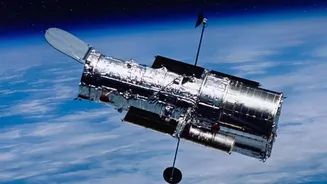
the Hubble Space Telescope to life. The Roman telescope is designed not to replace its predecessors, but to complement them with a unique and powerful capability: an immense field of view. While Hubble and Webb take stunningly detailed close-ups of small patches of sky, Roman will create breathtaking panoramas, capturing vast swaths of the universe with comparable sharpness.
A Panoramic Window on the Universe
Roman's primary instrument, the Wide Field Instrument (WFI), is a 300.8-megapixel camera that gives it a field of view at least 100 times larger than Hubble's. This means Roman can survey the sky up to 1,000 times faster. To put that in perspective, where Hubble might spend days creating a mosaic image of a nearby galaxy piece by piece, Roman could capture a similarly deep image of a far larger area in a fraction of the time. This incredible survey speed is what makes the mission so ambitious. It will allow astronomers to build huge maps of the cosmos, charting billions of galaxies and stars to study the universe on an unprecedented scale.
Hunting for Dark Energy and Exoplanets
The telescope has two primary science goals. The first is to investigate two of the biggest mysteries in physics: dark energy and dark matter. Dark energy is the name for the mysterious force causing the universe's expansion to accelerate, while dark matter is an unseen substance that shapes how galaxies move and cluster. By mapping the distribution of billions of galaxies across cosmic time, Roman will help scientists test theories about what these enigmatic phenomena are. Its second major goal is to discover thousands of new planets outside our solar system, known as exoplanets. While previous missions like Kepler often found planets orbiting very close to their stars, Roman will use a technique called gravitational microlensing to find worlds on wider orbits, including analogs to nearly every planet in our own solar system. This method detects the way a planet's gravity briefly magnifies the light from a distant background star, revealing its presence. The mission is expected to find thousands of new planets, from rocky worlds to ice giants, and even rogue planets that wander through the galaxy untethered to a star.
A New Way to See Alien Worlds
Beyond its vast surveys, Roman is also equipped with a groundbreaking technology demonstrator called the Coronagraph Instrument. A coronagraph is designed to block the overwhelming glare from a star, allowing the faint light of an orbiting planet to be seen directly. The instrument on Roman is designed to be 100 to 1,000 times more effective than previous space-based coronagraphs. It will be the first active coronagraph in space, using deformable mirrors to actively correct for scattered starlight in real-time. While it's a technology demonstration, it aims to directly image Jupiter-sized planets and pave the way for future missions, like the proposed Habitable Worlds Observatory, which will seek to capture images of Earth-like planets.