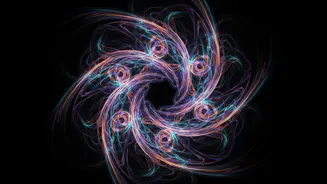









The Data Dilemma
Every email we send, every photo we upload, and every video we stream contributes to an ever-expanding digital universe. This explosion of data requires storage, and the hard drives and solid-state devices we rely on are facing a fundamental problem:
there's a limit to how small you can make the magnetic bits that store our ones and zeros. As we approach this limit, scientists are in a race to find new materials and methods to keep up with demand. The need for smaller, faster, and more energy-efficient data storage has never been more critical, pushing researchers to explore exotic states of matter and physics.
What is a Skyrmion?
First theorized in the 1960s for particle physics, a skyrmion is a robust, particle-like knot in a field. In magnetic materials, they are nanoscale regions where the electron spins arrange themselves into a stable, swirling vortex pattern. Think of it like a tiny magnetic hurricane, whose structure is topologically protected. This means that, like a knot in a rope, it can't be easily undone without a deliberate action. This inherent stability makes magnetic skyrmions promising candidates for data bits, as they are resilient to external disturbances. Their tiny size also promises ultra-high-density storage.
From Magnetism to Light
While magnetic skyrmions have been a major focus, a newer, even faster variant has emerged: the optical skyrmion. Instead of being formed by electron spins in a material, optical skyrmions are created by sculpting the properties of light itself—specifically its phase and polarization. Researchers can engineer these swirling topologies of light that are remarkably stable. The breakthrough came when scientists realized they could create these structures not just on the surface of exotic materials, but within freely propagating beams of light, opening a path toward all-optical computing and data transfer.
Writing and Reading with Lasers
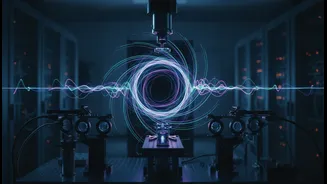
The potential of optical skyrmions for data storage lies in how they can be controlled. Using tools like spatial light modulators, scientists can precisely create, manipulate, and detect these light structures. Creating or annihilating a skyrmion at a specific location could represent writing a '1' or a '0'. Because this is done with light, the operations can happen at incredible speeds, potentially on the scale of femtoseconds (quadrillionths of a second). Reading the data would involve detecting the unique topological signature of the skyrmion. This light-based approach promises not just speed but also greater energy efficiency compared to moving magnetic bits.
Promise and Potential
The advantages are compelling. Optical skyrmions offer the potential for storage density far beyond current technology. Their topological nature provides robustness against noise and perturbations, making the stored data more secure. Furthermore, because they are light-based, they could be integrated into photonic circuits, leading to seamless, ultra-fast data processing and communication with minimal energy loss. Beyond binary, the unique structure of skyrmions could even allow for storing more information than a simple 0 or 1, further increasing data density.
Challenges on the Horizon
Despite the excitement, optical skyrmion technology is still in its early stages. A major challenge is making the creation and manipulation of these structures practical and scalable outside of a laboratory. Early methods often required complex and expensive metamaterials. However, recent breakthroughs have shown that skyrmions can be generated with much simpler setups, such as shining a laser on a tiny disc, which could make research more accessible. Ensuring the stability of these light structures over time and under various conditions is another critical hurdle that researchers are actively working to overcome before commercial applications become a reality.