




A Tale of Three Telescopes
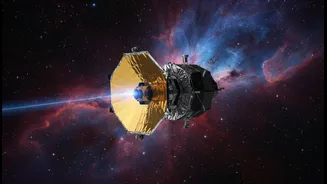
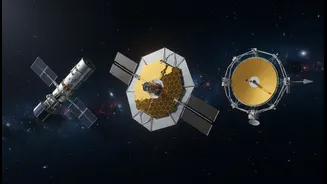
Think of NASA’s great observatories as a team of specialists. The Hubble Space Telescope, launched in 1990, is the veteran all-rounder, observing mainly in visible and ultraviolet light. The James Webb Space Telescope (JWST) is the powerful infrared specialist,
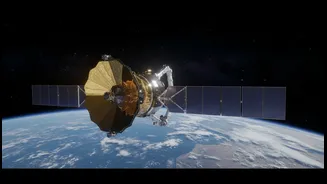
designed to peer deep into the early universe. The Nancy Grace Roman Space Telescope, set to launch by late 2026, is the team’s new surveyor. Its primary mission isn't to zoom in on individual objects, but to rapidly scan huge patches of the sky, creating panoramic maps of the cosmos with incredible detail. They aren't competitors; they are complementary tools designed to work together, each with a unique role in unraveling the universe's secrets.
The Power of a Panoramic View
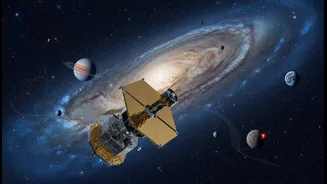
The single biggest difference between Roman and its predecessors is its immense field of view. While Roman has the same size primary mirror as Hubble (2.4 meters), its Wide Field Instrument can capture an area of the sky at least 100 times larger in a single snapshot. Imagine looking at the night sky through a narrow drinking straw—that's Hubble or Webb. Now, imagine swapping that straw for a massive panoramic window—that's Roman. To create a mosaic of our neighboring Andromeda galaxy, Hubble required more than 400 separate images; Roman could do it in just two. This survey power allows Roman to map the universe thousands of times faster than Hubble, turning a painstaking process into an efficient exploration. It’s designed not just to see deeply, but to see widely.
Hunting for Dark Energy and Dark Matter
Roman's wide-angle vision is purpose-built to tackle two of the biggest mysteries in physics: dark energy and dark matter. Dark energy is the name given to the unknown force causing the universe's expansion to accelerate, while dark matter is the invisible stuff that provides most of the universe's gravitational scaffolding. To study them, astronomers need enormous datasets. Roman will provide this by measuring the positions and shapes of billions of galaxies over vast areas. By tracking how galaxy clusters are distributed and how their light is bent by gravity (a phenomenon called weak gravitational lensing), scientists can map the influence of dark matter and trace the history of cosmic expansion with unprecedented precision. Roman will also hunt for thousands of specific stellar explosions, called Type Ia supernovae, which serve as cosmic mile markers to measure the expansion rate of the universe.
A New Way to Discover Exoplanets
While telescopes like Kepler and TESS found thousands of planets by watching for the dip in starlight as a planet passes in front of its star (the transit method), Roman will primarily use a different technique called gravitational microlensing. This effect occurs when a star and its planet drift in front of a more distant background star. The gravity of the foreground system acts like a lens, briefly magnifying the light of the background star. The planet creates its own little blip in that magnification signal, revealing its presence, mass, and distance from its star. Microlensing is especially good at finding planets in wider orbits, similar to Jupiter or Saturn, and even rogue planets that roam the galaxy untethered to a star. This method will complement transit surveys and help complete the census of planetary systems in our galaxy.
A Surveyor Finding Targets for the Specialist
Roman is fundamentally a discovery machine. Its job is to create vast cosmic maps and catalogues of interesting objects and phenomena. Once Roman identifies something unusual—a strange galaxy, a potentially habitable planet, or a rare cosmic explosion—other telescopes can be called in for a closer look. The James Webb Space Telescope, with its powerful but narrow vision, is the perfect partner for these follow-up investigations. For instance, Roman's surveys will find thousands of new exoplanets, and Webb can then be pointed at the most promising ones to study their atmospheres in detail. This synergy, where Roman finds the targets and Webb performs the deep dive, will dramatically accelerate the pace of discovery and give humanity its most complete picture of the universe to date.