






What is an Analogue Black Hole?
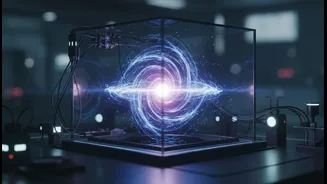
An analogue black hole isn't a real black hole at all. It doesn't have crushing gravity or a physical singularity. Instead, it's a system designed to behave in a mathematically similar way. Think of it like a flight simulator for pilots; it recreates
the conditions and challenges of flight without ever leaving the ground. In the same vein, scientists create scenarios where something—like sound waves or ripples in a fluid—cannot escape a certain point, much like how light cannot escape a real black hole's event horizon. The point of no return in these lab systems is an 'analogue event horizon'. This allows researchers to get a close-up look at the physics that are otherwise impossible to study across millions of light-years.
From Bathtubs to Quantum Gases
The methods for creating these analogues are surprisingly diverse and creative. One of the simplest examples is the 'draining bathtub' model, where water swirling down a drain creates a vortex. Ripples far from the vortex can travel freely, but as they get closer, the water flows faster than the ripples can move away, trapping them. This point where the flow speed exceeds the wave speed acts as the event horizon. More advanced experiments use exotic states of matter. Scientists have used superfluid helium, a fluid with zero viscosity, to create a 'quantum tornado' that mimics the gravitational pull around a rotating black hole. Another powerful tool is a Bose-Einstein condensate (BEC), an ultra-cold gas of atoms that acts like a single quantum object. By using lasers to make the BEC flow faster than the speed of sound within it, a 'sonic black hole' is formed where sound waves (phonons) get trapped instead of light waves.
The Search for Hawking Radiation
One of the biggest motivations for these experiments is to test one of Stephen Hawking's most profound predictions: that black holes are not completely black. In 1974, Hawking theorized that due to quantum effects at the event horizon, black holes should slowly leak energy in the form of thermal radiation, now known as Hawking radiation. This radiation is far too faint to be detected from actual astrophysical black holes against the backdrop of the cosmic microwave background. Analogue black holes offer a potential solution. Because the underlying mathematics are the same, these systems should also produce an analogue of Hawking radiation. In recent years, several experiments, particularly those using Bose-Einstein condensates, have reported the detection of spontaneous, thermal radiation that matches the predictions for Hawking radiation, a major breakthrough in validating this cornerstone of theoretical physics.
Why Not Just Use Telescopes?
While telescopes like the Event Horizon Telescope have managed to capture images of a black hole's shadow, they can only tell us so much. We can't poke a real black hole, send waves into it, or measure what comes out with precision. The environment around them is extreme and our view is obscured by distance and cosmic dust. Analogue experiments give scientists complete control. They can create a system, stimulate it with waves, and measure the results from every angle. This controlled environment is crucial for testing the subtle interplay between general relativity (the theory of gravity) and quantum mechanics, a major unresolved puzzle in modern physics. These tabletop setups allow for repeatable experiments that can probe the fundamental nature of spacetime in ways that are simply inaccessible to astronomy.
Testing More Than Just Black Holes
The value of analogue gravity extends far beyond just black holes. The same principles and experimental setups can be used to simulate other cosmological phenomena that are difficult or impossible to observe directly. This includes investigating processes from the very early universe, such as the rapid expansion of spacetime during cosmic inflation. By creating lab conditions that mimic the physics of the early cosmos, scientists hope to test theories about how the universe's fundamental structure emerged. These experiments are becoming a vital new tool for cosmology, providing a physical testbed for some of the most abstract and far-reaching ideas in physics and helping to bridge the gap between mathematical theory and observable reality.