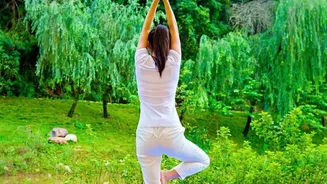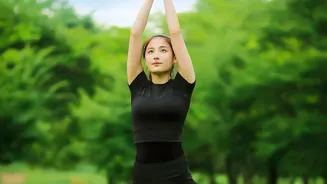




Tree Pose, or Vrksasana, is a beautiful expression of balance and focus. But what if you wobble? The good news is that this classic yoga posture is accessible to everyone. With a few simple modifications, you can find your roots and stand tall.
The Essence of Tree Pose
At its
heart, Tree Pose is about finding steadiness on one leg while the other is bent, mirroring the grounded yet upward-reaching nature of a tree. The benefits extend beyond the physical; while it strengthens your legs, ankles, and core, it also powerfully enhances concentration and mental focus. The posture asks you to find a single, unmoving point to gaze at—your 'drishti'—which helps to calm the mind and bring you into the present moment. The goal isn't to achieve a perfect, wobble-free stance overnight, but to embrace the process of finding your centre.
Modification 1: The Kickstand
This is the perfect starting point if you're new to balancing poses. Begin by standing tall in Mountain Pose (Tadasana), with your weight evenly distributed. Shift your weight onto your standing leg. Then, bend your other knee and turn it out to the side, placing the sole of your foot against your inner ankle with your toes remaining on the floor like a kickstand. This provides a point of contact with the ground, offering stability while you get used to the sensation of one-legged balancing. You can bring your hands to your hips or to a prayer position at your chest.
Modification 2: Foot on Calf
When you feel steady in the kickstand variation, you're ready to lift your foot higher. From Mountain Pose, shift your weight and lift your bent-knee foot to the inside of your standing calf. The key here is to actively press your foot into your calf and your calf back into your foot. This creates a stable connection. A crucial rule in all Tree Pose variations is to never place your foot directly on the knee joint, as this can cause strain. Keep your foot either above or below the knee. Hold your hands at your heart or on your hips to maintain focus.
Modification 3: Using a Wall for Support
Don't underestimate the power of a prop. Using a wall is an excellent way to build confidence and refine your alignment without the fear of falling. Stand with your side or your back to a wall. As you move into the pose, you can rest a hand, fingertips, or your back against the wall for support. This allows your body to learn the mechanics of the pose and build strength in the standing leg with an added layer of security. The wall provides just enough assistance to help you find your balance before you're ready to practice in the centre of the room.
Modification 4: Seated Tree Pose
Balance can be practised even while sitting down. This variation is ideal for anyone who finds standing for long periods challenging. Sit tall on the edge of a sturdy chair with your feet flat on the floor. Keeping your spine long, lift one foot and cross that ankle over the opposite knee or thigh, allowing the knee of the bent leg to open out to the side. This mimics the hip-opening action of the standing pose. You can keep your hands at your heart to complete the posture, receiving many of the same postural benefits.