







The IMF's Core Message: A Hybrid Approach
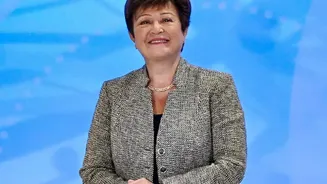
In a recent address at the IMF and World Bank annual meetings, Managing Director Kristalina Georgieva warned that the risks of AI could surpass its opportunities without robust safeguards and a clear ethical framework. She cautioned that while AI is already
boosting the global economy, its rapid, unregulated development is like 'a Formula One race car careening forward without safety barriers'. The core of her argument is that neither government nor industry can manage this transformation alone. Instead, she advocates for a hybrid model: a blend of industry self-regulation combined with significant government input and oversight to build confidence and ensure the technology's benefits are shared widely. This call to action positions the IMF as a key voice advocating for proactive, collaborative governance in the AI era.
The Role of Government: Building Guardrails and Safety Nets
According to the IMF, the primary role of governments is to establish the 'rules of the road' and protect their populations from the disruptive downsides of AI. This involves several key responsibilities. Firstly, governments must create stronger social safety nets to support workers whose jobs are displaced or transformed by automation. This includes funding for reskilling and upskilling programs to prepare the workforce for new demands. Secondly, policymakers are urged to develop regulations that set clear ethical standards for AI development and deployment. The IMF also stresses that for countries, particularly developing economies, to benefit from AI, they must first have essential preconditions in place, such as reliable electricity, widespread digital infrastructure, and a skilled workforce. Finally, governments need to review tax policies, as AI could shift economic value from labor to capital, potentially straining traditional sources of state revenue.
Industry's Mandate: Innovation with Responsibility
While governments set the boundaries, the private sector is tasked with driving the innovation that unlocks AI's productivity gains. The IMF acknowledges that tech companies are best positioned to lead the charge, given the fast-evolving nature of the technology. However, this leadership comes with significant responsibilities. Industry is expected to take the lead in self-regulation, working collaboratively to establish common standards that build public trust in AI systems. This includes being transparent about how AI models work and ensuring they are secure. During the discussion, leaders like Anthropic co-founder Jack Clark echoed this sentiment, arguing that companies should not be the sole decision-makers about the technology's future. The IMF's vision requires major AI-producing nations and companies to engage not just with regulators but also with society at large to ensure development is aligned with public good.
The Economic Stakes: Productivity vs. Inequality
The push for a dual-track approach is rooted in a high-stakes economic balancing act. On one hand, AI presents an enormous opportunity, with some estimates suggesting it could add trillions of dollars to the global economy and significantly boost productivity. On the other hand, it poses a severe threat to economic equality. The IMF warns that AI could affect up to 40% of jobs worldwide, with advanced economies even more exposed. There is a significant risk that AI will hollow out middle-skilled jobs, creating a polarized labor market where high-skilled 'AI-savvy' workers see wage gains while others are pushed into lower-paying service roles. Furthermore, if the promised productivity gains from massive AI investments fail to materialize quickly, it could lead to a sharp market correction and financial instability. This makes managing the transition essential not just for social harmony but for macroeconomic stability.