

A Piece of the Moon on Earth
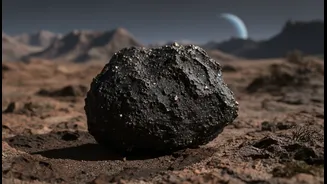
A lunar meteorite, sometimes called a lunaite, is exactly what it sounds like: a piece of the Moon that has fallen to Earth. It’s not a rock that simply resembles a moon rock; its origin is confirmed by scientists who compare its specific mineralogy,
chemical makeup, and isotopic composition to the samples brought back by the Apollo missions. The first was identified in 1982 from a sample found in Antarctica. Since then, hundreds more have been discovered, mostly in the deserts of Antarctica and northern Africa, where the dry conditions help preserve them. In total, over 1,090 kg of this material has been recovered, offering a growing library of lunar material for study.
An Unlikely Cosmic Journey
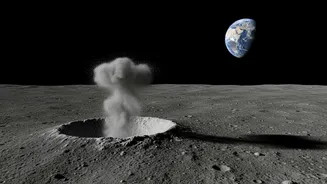
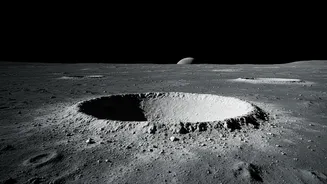
How does a rock from the Moon end up on our planet? The process begins with a powerful impact. Because the Moon has no significant atmosphere, it is constantly bombarded by asteroids and comets. When a sufficiently large object strikes the Moon, the force of the collision can eject surface material at speeds exceeding the Moon's escape velocity, which is about 2.4 kilometres per second. These ejected rocks then travel through space. Some enter orbit around the Earth, eventually falling through our atmosphere, while others may orbit the Sun for thousands or even millions of years before a chance encounter with Earth. This cosmic-ray exposure allows scientists to determine how long ago the rock left the Moon, with most having been ejected in the last 20 million years.
A More Complete Picture
The 382 kg of samples returned by the six Apollo missions are invaluable, but they come with a limitation: they were all collected from a relatively small, geochemically unusual area on the Moon's nearside. Lunar meteorites, on the other hand, are random samples from all over the Moon, including the far side which we never see from Earth. This makes them crucial for developing a more representative and global understanding of the Moon's geology. They are, in effect, 'free' samples delivered by nature, complementing the targeted sampling of space missions. By studying these random fragments, scientists gain a broader view of the Moon's composition and have challenged and refined ideas developed solely from the Apollo samples.
Unlocking Lunar Secrets
These celestial messengers carry stories of the Moon's violent past. Most lunar meteorites are breccias, which are rocks composed of various fragments fused together by the heat and pressure of past impacts. By studying these, scientists can piece together a timeline of bombardment. A recent study of a lunar meteorite from Northwest Africa revealed evidence of three distinct impact events, including a massive one about 3.5 billion years ago that was powerful enough to turn the surface molten. Another meteorite found in 2023 provided evidence of volcanic activity just 2.35 billion years ago, filling a major gap in our knowledge of the Moon's thermal history. These rocks are a tangible record of geological processes that have long since ceased on Earth, providing a unique window into the early solar system.