




The Legend of Hubble's Longevity
For over three decades, the Hubble Space Telescope has been a resilient eye on the cosmos, but its story could have been a short-lived tragedy. Launched in 1990 with a flawed primary mirror, its initial images were disappointingly blurry. Because Hubble was
designed from the ground up to be serviced, however, its fate was not sealed. In 1993, Space Shuttle astronauts performed a daring spacewalk to install corrective optics, effectively giving the telescope a new pair of glasses. This was just the first of five servicing missions. Over the years, astronauts replaced aging gyroscopes, installed more powerful cameras, and upgraded its scientific instruments. This ability to repair and enhance the observatory is the primary reason Hubble has remained a premier scientific tool for so long, far exceeding its original mission lifespan. It proved that investing in serviceability could pay massive scientific dividends.
A Magnificent, But Finite, Successor
The James Webb Space Telescope (JWST) represents a different design philosophy, born of necessity. To achieve its goal of observing the faint infrared light from the early universe, Webb needed to be incredibly cold and far from Earth's heat. Its operational home is the second Lagrange point (L2), a gravitationally stable spot about 1.5 million kilometres from Earth. This location is far beyond the reach of any crewed spacecraft, making astronaut servicing impossible. Consequently, JWST was designed as a single-deployment mission. Its success hinged on a flawless launch and a complex, multi-stage unfolding process. While its performance has been spectacular, its lifespan is finite, limited by the amount of fuel on board for station-keeping and the eventual failure of non-replaceable components. This makes it a magnificent but ultimately disposable masterpiece.
A Shift in Design Philosophy
As NASA and its partners plan for the next great flagship mission, the Habitable Worlds Observatory (HWO), the lessons from both Hubble and Webb are shaping a new approach. The HWO, slated for launch in the late 2030s or early 2040s, will also operate at the distant L2 point. But instead of accepting a finite lifespan, NASA is mandating that the multi-billion-dollar observatory must be designed for robotic servicing from its inception. This represents a fundamental shift away from the single-lifecycle model of JWST. The goal is to create a sustainable asset in deep space, one that can be maintained, repaired, and even upgraded with next-generation technology decades after its launch. The primary driver, according to NASA officials, is the ability to install new scientific instruments, ensuring the telescope remains at the cutting edge for years to come.
Building a Robot-Friendly Telescope
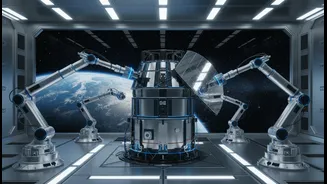
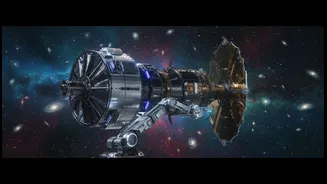
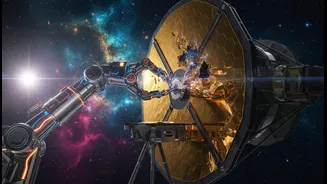
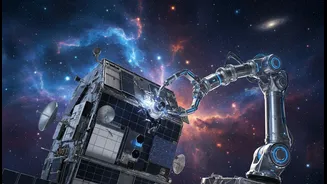
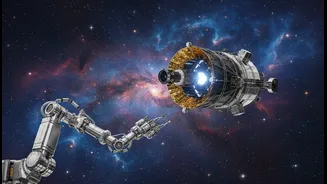
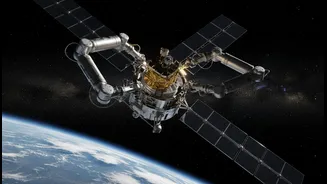
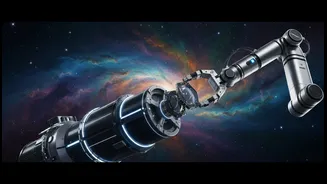
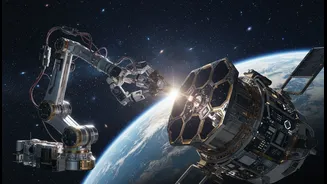
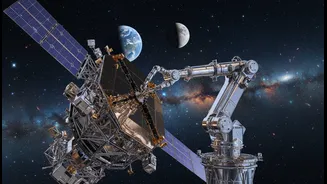
What does a robot-friendly space telescope look like? The design requires a modular architecture. Instead of a single, integrated bus, critical systems like avionics, computers, and sensors will be designed as standardized modules known as Line-Replaceable Units (LRUs). These modules will feature common docking interfaces, self-aligning connectors, and guide pins that make them easy for a robotic servicer to grasp, remove, and replace. NASA envisions autonomous or remotely operated spacecraft that can rendezvous with the HWO, latch on, and perform complex tasks. These robotic missions could refuel the observatory, replace a faulty reaction wheel, or slide out an old instrument to insert a new one developed years after the initial launch. This approach not only extends the telescope's life but future-proofs the investment.
The Future of Cosmic Construction
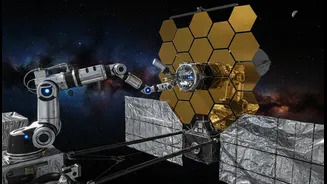
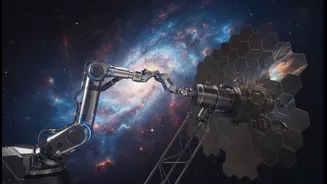
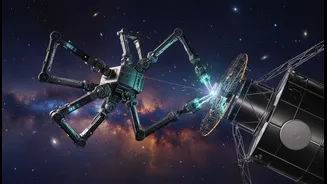
The concept of serviceability is even extending to how these giant observatories are built. Some proposals suggest that if a telescope's primary mirror is too large to fit in a single rocket fairing, robotic servicers could assemble the mirror segments in orbit. More advanced concepts explore swarms of small, self-assembling modules that could form an enormous telescope mirror in space, built up incrementally over time. These ideas, once the stuff of science fiction, are now being seriously studied by engineers at NASA and academic institutions. By embracing modularity and robotics, the next generation of space observatories will not just be launched into space; they will be built to last and evolve within it, maximizing our ability to explore the universe and answer humanity's oldest questions.