





Choose Your Luggage Wisely
The battle for boot space is often won or lost before you even start packing. While hard-shell suitcases offer great protection, they are rigid and unforgiving. Soft-sided bags, like duffels or canvas holdalls, are your best friends when space is tight.
They can be squeezed into irregular gaps and moulded to fit around the awkward corners and wheel wells inside the boot, making use of every available inch. If you must use trolley suitcases, consider a mix: perhaps two hard-shells for fragile items and two soft bags for everything else. This hybrid approach gives you both protection and flexibility.
Establish a Solid Foundation
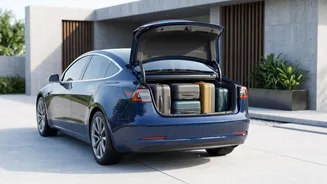
The golden rule of packing a car boot is to start with the heaviest items. Place your largest and heaviest suitcases flat on the floor of the boot, pushed as far forward as possible, against the back of the rear seats. This creates a stable base and helps maintain the car's centre of gravity, which is important for safe handling on the road. Distributing the weight evenly across the boot floor is also crucial. Avoid placing all the heavy bags on one side. This foundational layer is the most critical step in achieving a stable and space-efficient pack.
Master the Art of 'Tetris' Packing
With your heavy base layer in place, it's time to think in three dimensions. Treat packing the rest of your luggage like a puzzle. Stand a suitcase upright if it fits better that way, or lay it flat. Alternate the orientation of your bags to minimise empty space. The goal is to create a solid, interlocked wall of luggage. This is where the mix of hard and soft bags pays off. The rigid suitcases can form the main structure, while the softer bags can be wedged into the gaps. Look at everything you need to pack before you start, so you can plan the arrangement.
Fill Every Nook and Cranny
Once the main suitcases are in, you'll notice small, awkward gaps. Do not let them go to waste. This is where smaller, softer items come into play. Rolled-up towels, jackets, pillows, and small backpacks are perfect for plugging these holes. This not only maximizes your space but also stops things from shifting and rattling around during the journey. Check for hidden compartments in your boot, such as the space around the spare tyre, which can often hold smaller items. By filling every void, you create a tightly packed, secure load.
Pack for the Journey, Not Just the Destination
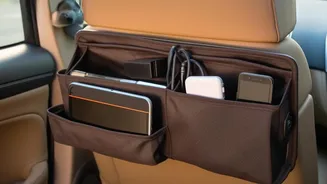
Remember that the first bag you pack into the back of the boot will be the last one you can access. Think about what you might need during the drive. Essentials like a first-aid kit, snacks, water, phone chargers, and a change of clothes for kids should be packed last, so they are easily accessible near the boot opening or kept in the passenger cabin. Having a separate, smaller 'day bag' with these essentials prevents you from having to unpack half the boot at a rest stop just to find a charging cable.
Is It Always Possible?
While these techniques dramatically increase what you can fit, the headline's promise depends on your specific car and suitcases. A medium suitcase is typically 60-70 cm tall. Popular small sedans in India like the Maruti Dzire (around 378 litres) and Honda Amaze (around 420 litres) have generous boots for their class. Four medium suitcases can theoretically fit, but their rigid shape is the main challenge. Using soft bags and packing cubes significantly improves your chances. The key is to see this as a strategic goal, not an absolute guarantee for every car and every bag combination.