


The Sun’s Destructive Potential
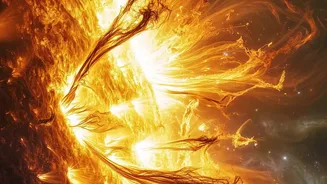
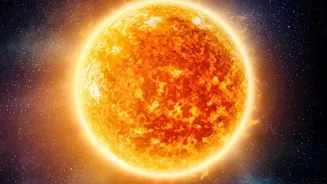
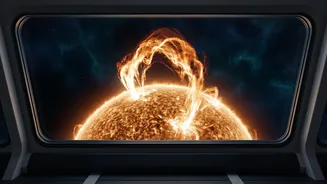
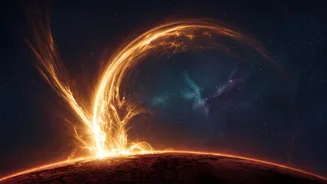
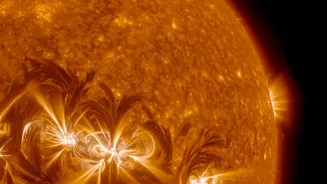
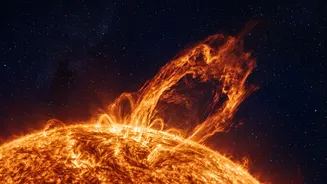
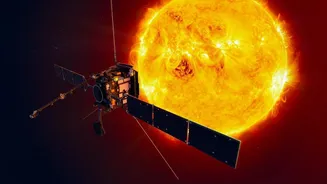
Our modern world runs on electricity and data. A severe solar storm, like the historic Carrington Event of 1859, would be calamitous in today's technology-dependent society. These storms begin with events like solar flares or coronal mass ejections (CMEs),
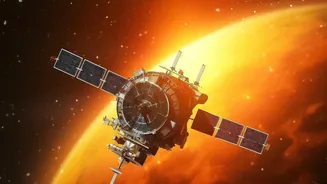
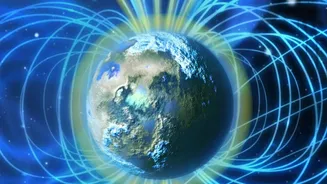
which are massive explosions on the Sun’s surface that hurl charged particles into space. If Earth is in the path of one of these eruptions, the consequences can be severe. The incoming energy can induce powerful electrical currents in our power lines, potentially damaging high-voltage transformers and causing widespread, long-lasting blackouts. Beyond the grid, this space weather can disable satellites, disrupting GPS, communications, and weather forecasting, and even pose a radiation risk to astronauts and airline crews on polar routes.
The Promise of AI Forecasting
Traditionally, space weather prediction has relied on a network of satellites monitoring the Sun, giving us, at best, a few hours or days of warning. This is often not enough time to adequately protect sensitive infrastructure. This is where artificial intelligence comes in. AI models, particularly deep learning networks, are exceptionally good at finding subtle patterns in vast and complex datasets. Scientists are now training AI on decades of solar observations from various satellites. The goal is to teach these models to recognize the faint precursor signals that indicate a major eruption is imminent. Models like DAGGER (Deep Learning Geomagnetic Perturbation), developed with NASA, can already provide 30-minute warnings for specific geomagnetic disturbances on Earth, a significant step forward.
The Data Scarcity Problem
One of the biggest hurdles for AI is a simple one: a lack of good examples. While the Sun is constantly active, truly massive, Earth-directed storms are rare. Machine learning models learn from the data they are trained on, and if they have few or no examples of the extreme events they are supposed to predict, their forecasts become unreliable. An AI might become excellent at predicting minor solar activity simply because that’s what most of the historical data shows. However, it may fail completely when faced with the unprecedented conditions of a once-in-a-century superstorm because it has never seen anything like it in its training data. This makes it difficult for forecasters to trust an AI model for the very events that pose the greatest risk.
Physics, Not Just Patterns
Predicting the Sun isn't just a pattern-recognition problem; it's a physics problem. The magnetic activity inside the Sun that drives these storms is incredibly complex and chaotic. While AI is great at interpolating—finding connections within the data it already knows—it struggles with extrapolation, which is predicting outcomes outside of its learned experience. Physics-based models attempt to simulate the underlying mechanics of the Sun, but these are computationally expensive and slow. AI models are much faster, but they often operate without a true understanding of the physics involved. This means they can miss novel events or be thrown off by conditions that don't fit the patterns they have memorized.
The 'Black Box' Dilemma
Another significant challenge is the "black box" nature of many advanced AI models. A deep learning model might issue a critical warning, but it can be very difficult for scientists to understand why it made that prediction. This lack of interpretability is a major issue when the stakes involve shutting down national power grids or repositioning billion-dollar satellites. Before taking such drastic measures, operators need to have confidence in the forecast, and that often means understanding the reasoning behind it. For AI to be fully adopted, it must not only be accurate but also transparent enough for human experts to trust and verify its conclusions.