





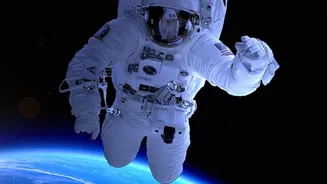

A Personal Bubble of Pressure
Space is a near-perfect vacuum, meaning it has virtually no atmospheric pressure. On Earth, the air around us constantly pushes on our bodies, and our bodies push back. This balance is crucial for life. Without that external pressure, the liquids in our body
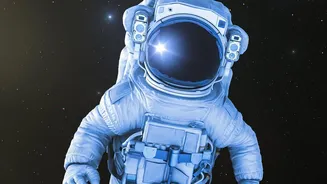
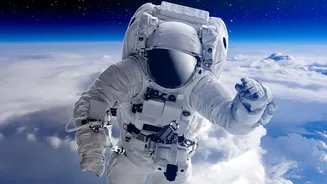
would begin to boil, not due to heat, but because the boiling point drops dramatically. This phenomenon, known as ebullism, would cause bubbles to form in our bodily fluids and tissues. An astronaut exposed to this vacuum would lose consciousness in about 15 seconds from lack of oxygen. A spacesuit, or Extravehicular Mobility Unit (EMU), solves this by creating a pressurised bubble of breathable air, essentially providing a small, human-shaped pocket of Earth's atmosphere. This pressurised layer keeps body fluids in a stable liquid state.
Oxygen to Breathe, Water to Drink
Beyond pressure, the most obvious need is a supply of breathable air. A spacesuit's backpack, called the Portable Life Support System (PLSS), contains tanks of pure oxygen. But just providing oxygen isn't enough; the suit also has to get rid of the carbon dioxide that the astronaut exhales. Fans circulate the air through lithium hydroxide canisters, which scrub the CO2, preventing a toxic buildup. This closed-loop system allows an astronaut to work outside the spacecraft for up to eight hours. The suit even includes an in-suit drink bag, a small pouch of water with a straw positioned near the astronaut's mouth, ensuring they can stay hydrated during long spacewalks.
Surviving Extreme Temperatures
In Earth orbit, an astronaut experiences a brutal temperature swing every 90 minutes as the International Space Station moves between sunlight and shadow. In direct sunlight, temperatures can soar to 121°C (250°F), while in darkness they can plummet to -157°C (-250°F). To manage this, the suit is brilliantly white to reflect as much solar radiation as possible. But the real secret is the Liquid Cooling and Ventilation Garment (LCVG). This is a set of full-body long underwear woven with about 300 feet of thin tubes. Chilled water circulates through these tubes, picking up excess body heat from the astronaut and carrying it to a radiator on the backpack, where it's released into space. This personal cooling system is vital to prevent the astronaut from overheating while performing physically demanding tasks.
A Shield Against Dangers Seen and Unseen
Space is not empty. It's filled with radiation and tiny, fast-moving particles. Without the Earth's protective atmosphere and magnetic field, astronauts are exposed to high levels of solar and cosmic radiation, which can damage DNA and increase long-term health risks like cancer. The spacesuit's helmet visor has a thin coating of gold that reflects harmful ultraviolet and infrared radiation, acting like a super-powered pair of sunglasses. The suit itself is made of multiple layers—up to 16 in some areas—that provide limited shielding. These layers also serve as a form of armour. Micrometeoroids and flecks of orbital debris, some no bigger than a grain of sand, travel at speeds of up to 27,000 kilometres per hour. At that velocity, even a tiny object can cause catastrophic damage. The suit's outer layers, made of tough materials like Kevlar and Nomex, are designed to break up these particles before they can puncture the critical inner pressure bladder.