


A Sibling Storm Emerges
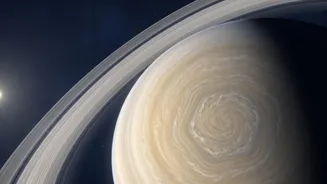
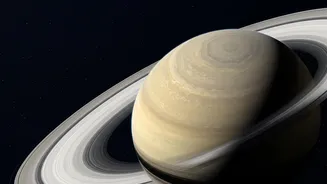
Astronomers have discovered a massive, ten-sided atmospheric feature, or decagon, churning in the clouds around Saturn's south pole. The discovery, detailed in early September 2026, was made using data from the Hubble Space Telescope’s Outer Planet Atmospheres
Legacy (OPAL) program, which annually monitors the gas giants. This marks the first time a persistent, polygonal weather pattern has been spotted in the planet's southern hemisphere, offering a fascinating parallel to the famous hexagon at the north pole. However, this southern storm is a new development. The Cassini spacecraft, which orbited Saturn from 2004 to 2017, saw no such long-lived feature. Hints of the decagon only began appearing in images from 2023, making this a rare chance for scientists to watch a planetary-scale storm system form in near real-time.
A Tale of Two Polygons
While both poles now host a geometric marvel, the two are not identical twins. The northern hexagon has been a stable fixture for over 40 years, first spotted by the Voyager probes in the 1980s. Its sides are each about 14,500 kilometers long, and it remains relatively stationary. The new southern decagon, by contrast, appears to be a more recent and possibly evolving feature. With ten sides instead of six, it suggests that the underlying physics of Saturn's atmosphere can produce different outcomes under slightly different conditions. Scientists believe the number of sides in such a wave relates to the specific speed and width of the jet stream that contains it. So, while both poles make polygons, they don't follow the exact same blueprint.
What Is an Atmospheric Wave?
These giant geometric shapes are not solid structures, but rather visible patterns in the planet’s powerful jet streams. Known as planetary or Rossby waves, they are massive-scale disturbances in a rotating planet's atmosphere. Think of them like standing waves—similar to the way a plucked guitar string vibrates in a stable pattern. In a planet's atmosphere, instabilities in a powerful, circling jet stream can get locked into a repeating, resonant pattern that becomes visible in the cloud tops. The Hubble observations confirm the decagon is not just a surface-level feature; it extends deep into Saturn's atmosphere, indicating it's a vertically significant structure, just like its northern counterpart.
A New Chapter for Planetary Science
The discovery of the decagon is significant because it proves Saturn's northern hexagon wasn't a complete anomaly. It suggests that forming giant, polygonal weather systems is a fundamental behavior of Saturn's atmosphere, given the right conditions. For years, Saturn's south pole was tilted away from Earth's view, hiding its secrets. Only as the planet's long seasons changed, bringing the pole back into view around 2023, could ground-based observers and eventually Hubble spot the emerging pattern. The initial hints were even noticed by amateur astronomers before being confirmed by professional analysis of Hubble data. This new discovery opens the door to comparing two similar-yet-different natural laboratories on the same planet, which could help unlock the secrets of how atmospheres on gas giants work.