






A New World Next Door
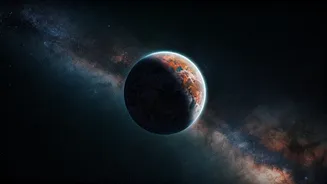
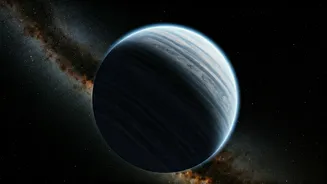
The source of this excitement is Gliese 12 b, an exoplanet located a mere 40 light-years away. While that sounds distant, in galactic terms, it's practically a next-door neighbour. Discovered by an international team of scientists using NASA's Transiting
Exoplanet Survey Satellite (TESS), this planet is special for several reasons. It is roughly the size of Earth, maybe slightly smaller like Venus, and orbits a cool red dwarf star. This discovery has been hailed as finding the nearest, transiting, temperate, Earth-sized world to date, making it an exceptional candidate for closer inspection.
The 'Goldilocks' Conundrum
Gliese 12 b orbits its star in what is known as the "habitable zone," or the 'Goldilocks zone'. This is the region where conditions are not too hot and not too cold for liquid water—a key ingredient for life as we know it—to potentially exist on the surface. The planet has an estimated surface temperature of around 42 degrees Celsius, assuming it has no atmosphere. This is warmer than Earth's average but significantly cooler than many of the thousands of other exoplanets found so far. However, its true surface conditions depend entirely on whether it has an atmosphere and what that atmosphere is made of. It could be a temperate world, a scorching greenhouse like Venus, or a barren rock with no air at all.
The Search for an Atmosphere
The next, most crucial step is to determine if Gliese 12 b has an atmosphere. Because the planet 'transits'—or passes in front of its star from our viewpoint—astronomers can use powerful tools like the James Webb Space Telescope (JWST) to study the starlight that filters through its atmosphere. Different gases absorb light in unique ways, leaving behind chemical fingerprints. Scientists will be hunting for signs of water vapour, carbon dioxide, and other molecules that could hint at a planet's ability to support life. This makes Gliese 12 b a prime target to understand why Earth is a thriving oasis while its 'twin' Venus is a toxic inferno, as this new planet's temperature falls right between the two.
A Beacon for Future Exploration
For India, a nation with soaring space ambitions, discoveries like Gliese 12 b are more than just cosmic curiosities. They are powerful catalysts that inspire a new generation of scientists, engineers, and dreamers. As ISRO continues to push the boundaries with missions to the Moon, Mars, and beyond, the global search for habitable worlds provides a compelling context for our own journey into space. Each new world found underlines the importance of developing advanced space technology and fostering a spirit of scientific inquiry. It reinforces the idea that exploring the universe is a collective human endeavour, one in which India is an increasingly vital partner.
A Universe of Possibilities
It is important to manage expectations. Finding a planet in the habitable zone is not the same as finding life. The process of confirming an atmosphere, let alone detecting biosignatures, is incredibly complex and time-consuming. The host star, Gliese 12, is a relatively calm red dwarf, which is a good sign, as more active stars can strip planets of their atmospheres with powerful flares. But even with this advantage, the road ahead is long. Yet, the hope that Gliese 12 b provides is immense. It is a perfect natural laboratory, offering one of our best chances yet to study an Earth-sized world that could tell us so much about our own origins and the potential for life elsewhere in the galaxy.