



The New Space Race is Private
The Indian space landscape has transformed dramatically since the sector was opened to private participation in 2020. Today, companies like Skyroot Aerospace, Agnikul Cosmos, and Pixxel are developing everything from launch vehicles to satellite constellations,
creating thousands of new, high-paying jobs. This commercial boom, supported by government bodies like IN-SPACe, means that careers in space are more accessible than ever, extending far beyond traditional government roles. The Indian space economy is projected to grow from around $9 billion to over $40 billion in the next decade, fueling a massive demand for skilled talent. For students, this signals a clear message: the time to prepare for a career in space-tech is now.
Core Engineering Fundamentals
At the heart of every rocket launch and satellite deployment are core engineering principles. A strong foundation in aerospace, mechanical, electronics, and electrical engineering remains the most direct pathway into technical roles. These disciplines govern the design of launch vehicles, propulsion systems, and the intricate hardware that must survive the harsh environment of space. While new specializations are emerging, a deep understanding of fundamentals like fluid dynamics, thermodynamics, and materials science is non-negotiable for anyone looking to build the physical systems that power India's space ambitions. Universities like the IITs, NITs, and the Indian Institute of Space Science and Technology (IIST) are primary sources for this talent.
Software, AI, and Machine Learning
Modern spacecraft are as much about code as they are about mechanics. Software is the brain of any mission, controlling everything from autonomous navigation to flight systems and data transmission. As a result, proficiency in programming languages like Python, C++, and MATLAB is highly sought after. Furthermore, Artificial Intelligence (AI) and Machine Learning (ML) are becoming critical. These technologies are used for analysing vast amounts of satellite data, predicting equipment failures, enabling autonomous rovers, and even discovering new exoplanets. ISRO and private firms are actively developing AI solutions for mission trajectory design, big data analytics, and space robotics, making this one of the fastest-growing skill areas.
Satellite Data Analysis and GIS
One of the most significant commercial opportunities in space is the data generated by satellites. Earth observation satellites collect enormous volumes of imagery and signals used in agriculture, disaster management, urban planning, and climate science. This has created a surge in demand for Satellite Data Analysts and Remote Sensing/GIS experts. These roles require skills in processing and interpreting large datasets. Familiarity with Geographic Information Systems (GIS) tools, image processing techniques, and data analysis using Python is essential for turning raw satellite data into actionable insights for clients on the ground. Companies like Pixxel are at the forefront of this data revolution.
Robotics and Autonomous Systems
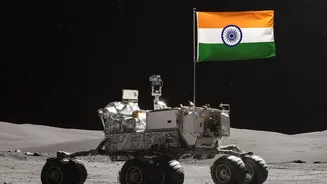
As missions become more complex, the need for advanced robotics and automation is growing. This field is crucial for everything from building smart manufacturing systems for space components to developing robotic arms for in-orbit servicing and rovers for planetary exploration. Engineers with skills in robotics can work on creating autonomous systems that can navigate challenging terrains on other worlds or perform delicate repair tasks on satellites in orbit. This specialization combines mechanical engineering, electronics, and AI to build machines that can function with minimal human intervention, a vital capability for deep space exploration.
Beyond Engineering: Law, Policy, and Business
The new space ecosystem isn't just for engineers. As the sector commercializes, there is a growing need for professionals with expertise in space law, public policy, and business development. Lawyers are needed to navigate international space treaties, intellectual property, and licensing for private launches. Policy advisors help shape the regulatory frameworks that govern the industry, while business professionals drive sales, strategy, and investment for space startups. For students in non-technical fields, developing a deep understanding of the space domain can open up unique and influential career paths within this exciting industry.