

A 'New' 10-Sided Southern Storm
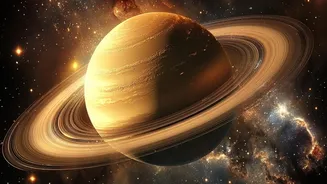
While Saturn's six-sided northern storm, the hexagon, has been known for decades, recent observations have unveiled a new geometric marvel. As of late 2025 and early 2026, astronomers using the Hubble Space Telescope have confirmed the emergence of a 10-sided
pattern, or decagon, encircling the planet's south pole. This feature appears to be a recent development, with data suggesting it began forming around 2023 and has been strengthening since. Unlike the long-stable hexagon, this southern decagon gives scientists a rare, real-time look at how such massive atmospheric structures are born and evolve on a gas giant.
The Shape is a Giant Jet Stream
These geometric patterns aren't solid structures but are actually the path of a powerful jet stream. Think of it like the jet streams on Earth that influence our weather, but on a much grander and more orderly scale. On Saturn, this river of atmospheric gases moves at incredible speeds, over 320 kilometres per hour, confining a massive polar vortex. The straight sides and sharp corners of the hexagon (and likely the new decagon) are formed by this jet stream creating a massive, stable wave pattern that rotates at almost the same speed as the planet itself. This is why the pattern appears stationary over the pole, rather than drifting like a typical cloud.
It's All About Fluid Dynamics
So, why a hexagon or a decagon? The answer lies in fluid dynamics. Laboratory experiments have shown that when a circular tank of fluid is rotated at different speeds at its center and edges, polygonal shapes can spontaneously form in the turbulent area between the flows. Depending on the conditions, shapes with three to eight sides have been created in these lab settings. On Saturn, the steep difference in wind speeds between the polar jet and adjacent atmospheric zones creates instabilities that settle into a stable, geometric standing wave, known as a Rossby wave. The number of sides depends on the precise conditions, which is why the north pole settled on six sides, while the south pole has now formed ten.
The Pattern Extends Deep Into the Atmosphere
This isn't just a surface-level illusion. The hexagon is estimated to be around 300 kilometres high, extending deep into Saturn's atmosphere. Recent studies have shown the structure's influence reaches hundreds of kilometres vertically, from the main cloud decks up into the stratosphere. This depth is a key reason for its stability. The entire system is anchored by a massive polar cyclone, similar to a hurricane on Earth but vastly larger. This powerful central vortex, combined with the jet stream, helps organize and stabilize the entire geometric pattern, making it a true three-dimensional weather system.
It Changes Colour with the Seasons
During its long mission, the Cassini spacecraft observed Saturn's northern hexagon change colour, shifting from a mostly blue hue to a more golden one between 2012 and 2016. This colour change is tied to Saturn's long seasons. As the north pole tilted toward the Sun for its summer, the increased sunlight likely triggered chemical reactions in the atmosphere, creating a haze that gave the hexagon its yellowish tint. In the dark winter, these chemical compounds likely break down, returning the colour to blue. This seasonal variability shows that despite its stable shape, the hexagon is a dynamic and evolving atmospheric feature.