



Ripples in Spacetime
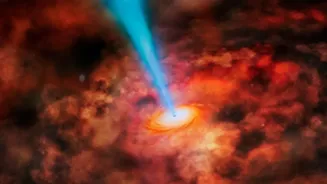
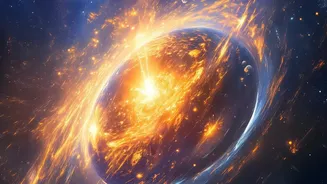
First predicted by Albert Einstein, gravitational waves are ripples in the very fabric of spacetime, created by the most violent cosmic events. Think of it like dropping a stone into a pond; massive, accelerating objects like colliding black holes or
neutron stars create waves that travel outwards at the speed of light. In 2015, the Laser Interferometer Gravitational-Wave Observatory (LIGO) made history by detecting these waves for the first time, opening a new window to the universe. These detections, however, came from relatively recent and 'loud' events. The true prize for cosmologists is a much fainter, more ancient signal.
The Universe's Faintest Whisper
Scientists believe the Big Bang itself created a faint, persistent hum of gravitational waves that still fills the entire cosmos. This is known as the stochastic gravitational wave background (SGWB). Unlike the sharp 'chirp' of a black hole merger, this background is a constant, random signal, like the combined murmur of a massive crowd. Detecting it is like trying to hear the hum of a single light fixture during a rock concert. This primordial hum is drowned out by the noise of countless recent cosmic events, not to mention the noise from the detectors themselves. This makes finding it one of the biggest challenges in modern astrophysics.
A New Cosmic Filter
The new breakthrough isn't a bigger, more powerful telescope, but a smarter way to analyse the data we already have. Researchers have developed a sophisticated data-processing technique designed to sift through the overwhelming 'foreground' noise of recent astrophysical events. The method involves meticulously modelling and subtracting the signals from known sources, like binary black hole mergers. By accurately characterising and removing these louder 'conversations', scientists can better isolate the underlying, fainter signal. The key is to account for the uncertainties in these subtractions, which previous methods struggled with. By cross-correlating data between multiple detectors, such as LIGO and its European partner Virgo, the technique can distinguish a true cosmic signal from local instrumental noise.
Unlocking Secrets of the Big Bang
If this technique successfully isolates the primordial background, the payoff would be immense. These ancient gravitational waves hold secrets about the universe's first fraction of a second, an era that light cannot penetrate. They could provide the first direct evidence for 'cosmic inflation', the theory that the universe underwent a period of explosive expansion moments after its birth. The properties of these waves could tell us about the fundamental physics that governed this era, potentially revealing new particles or forces that are otherwise impossible to study. It would be the cosmic equivalent of finding a fossil from the moment life first began on Earth.
The Road Ahead
While this new data analysis method is a significant step forward, a confirmed detection of primordial gravitational waves is not yet guaranteed. The technique must be applied to vast amounts of data from current and future detectors. Next-generation observatories, which will be even more sensitive, are expected to provide the quality of data needed for this method to truly shine. Future space-based observatories like LISA will also search for these signals at different frequencies. Scientists hope that as our detectors improve and this filtering technique is refined, we can finally tease out the details of the universe's birth certificate, written in the language of gravitational waves.