






A Junkyard Above Our Heads
Since the dawn of the space age, we've been leaving things behind. Low Earth Orbit (LEO), the crucial highway for satellites and space stations, is now dangerously cluttered. This isn't just a few stray items; according to NASA, there are over 100 million
particles of debris larger than a millimeter orbiting Earth. This includes everything from defunct satellites and spent rocket stages to tiny flecks of paint and metal fragments from past collisions. Travelling at speeds exceeding 28,000 kilometers per hour, even a minuscule object can strike with enough force to disable a functioning satellite, putting our global communication, navigation, and weather forecasting systems at risk. The European Space Agency notes that the number of fragmentation events, where debris collides and creates even more debris, is unfortunately increasing.
The Kessler Syndrome Threat
Scientists are concerned about a theoretical tipping point known as the 'Kessler Syndrome'. This scenario, proposed by NASA scientist Donald Kessler in 1978, describes a cascade effect where the density of objects in LEO is so high that collisions become inevitable, creating an exponential increase in debris. This could eventually create a debris belt so thick that it renders certain orbits unusable for generations, effectively trapping us on our own planet. Cleaning up this orbital junkyard isn't just a matter of tidiness; it's a critical step in ensuring the long-term sustainability of space activities and protecting a space economy valued at hundreds of billions of dollars.
Enter the Magnetic Tether
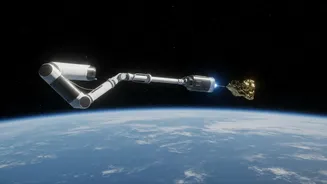
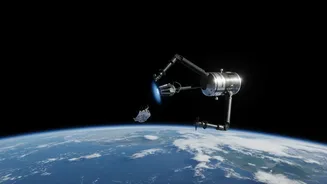
While ideas for cleanup have ranged from nets and harpoons to robotic arms, one of the most promising and elegant solutions is the electrodynamic tether. Imagine a long, thin ribbon, sometimes kilometers long but only a few centimeters wide, made of a conductive material like aluminum. This isn't a physical rope for lassoing junk. Instead, it uses a fundamental principle of physics to its advantage. Unfurled from a 'chaser' satellite, the tether interacts with Earth's magnetic field and the plasma in the upper atmosphere. This interaction naturally generates an electrical current, which in turn creates an electromagnetic drag force, known as the Lorentz force. This force acts like a brake, slowing the tether and anything attached to it without using a single drop of propellant.
How It Works in Practice
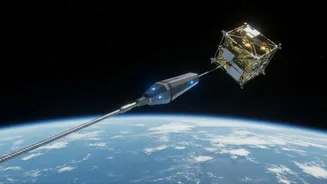
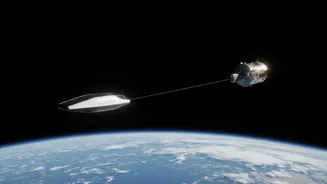
There are a few ways this technology can be applied. One method involves a chaser satellite attaching a tether to a large piece of debris, like a dead satellite. The tether then generates drag, causing the junk's orbit to decay much faster than it naturally would. Eventually, the debris is pulled low enough to burn up harmlessly in Earth's atmosphere. Another concept is the 'magnetic grapple', where a spacecraft uses powerful electromagnets to attract and secure a target object from a safe distance before initiating the deorbiting process. The major advantage is that these systems are largely passive and fuel-free, making them a scalable and potentially more cost-effective solution compared to propulsion-heavy alternatives.
India’s Focus on a Cleaner Cosmos
The problem of space debris is a global one, and India is taking significant steps to address it. The Indian Space Research Organisation (ISRO) is actively developing its own capabilities for monitoring and mitigating debris. Initiatives like the 'Debris Free Space Mission' (DFSM) aim for Indian missions to be zero-debris by 2030. ISRO is also exploring technologies like robotic arms for active debris removal and has demonstrated autonomous rendezvous and docking capabilities, which are crucial precursors for any cleanup mission. As of March 2026, there were 129 trackable pieces of debris from Indian missions in orbit, highlighting why domestic mitigation and cleanup strategies are essential. Adopting and contributing to technologies like magnetic tethers aligns perfectly with India's goal of ensuring safe and sustainable space operations for itself and the world.