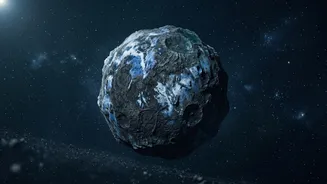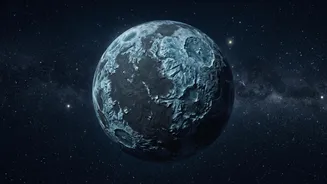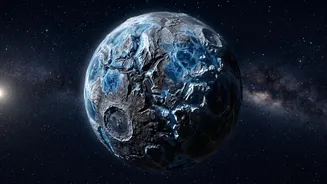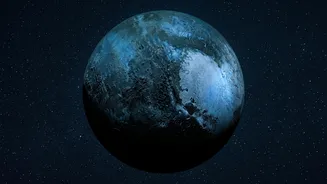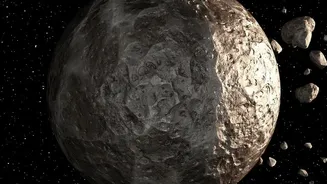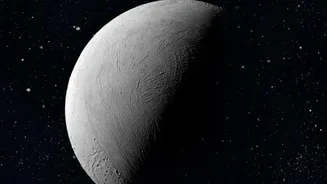




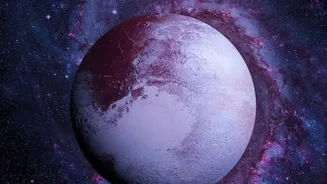
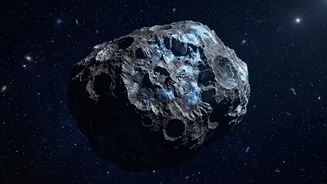

In the cold, dark expanse beyond Neptune, a newly spotted object is causing a stir. Dubbed 2026 ED138, this distant wanderer might be large enough to be a dwarf planet, but confirming its true nature presents a fundamental cosmic puzzle.
A New Object in the Cosmic Backyard
Deep within the
Kuiper Belt, a vast ring of icy bodies left over from the formation of our solar system, astronomers have identified a new point of light. This region, which begins beyond Neptune's orbit, is home to thousands of known objects, including Pluto. Discoveries like 2026 ED138 are exciting because each one offers a new clue about how our solar system came to be. The first Kuiper Belt Object after Pluto was found in 1992, and since then, our map of this distant realm has grown exponentially. However, spotting an object is just the first step. The real work begins when scientists try to figure out exactly what they are looking at, and for 2026 ED138, the biggest question is its size.
The Dwarf Planet Litmus Test
For an object to be classified as a dwarf planet, the International Astronomical Union (IAU) has a three-point checklist. First, it must orbit the Sun. Second, it must not be a moon (or satellite) of another planet. Third, it must have enough mass for its own gravity to pull it into a roughly spherical shape, a state known as hydrostatic equilibrium. This third criterion is the trickiest. An object's gravity needs to be strong enough to overcome its own material strength, smoothing out major lumps and bumps. While massive planets achieve this easily, smaller bodies in the Kuiper Belt exist right on the borderline. Determining if 2026 ED138 is round enough to pass this test is impossible without first knowing its dimensions.
The Deceptive Nature of Light
Measuring the size of an object billions of kilometres away is incredibly difficult. The primary challenge is a property called albedo, which is the fraction of light a surface reflects. Imagine two objects in the distance at night: a small, white snowball and a large, black piece of coal. From far away, they might appear to have the same brightness because the highly reflective snowball (high albedo) sends back more of the limited light it receives, while the large but dark coal (low albedo) absorbs most of it. This is the exact problem astronomers face with 2026 ED138. Is it a relatively small but highly reflective body made of bright ices, or is it a much larger object with a dark, rocky surface? Without knowing its albedo, its brightness in a telescope is a misleading clue to its size.
Innovative Tools for a Distant Puzzle
To solve the size-versus-albedo puzzle, astronomers employ several clever techniques. One method is to study the object's thermal emissions. By using powerful instruments like the James Webb Space Telescope, scientists can measure the heat it radiates. A large, dark object will be warmer than a small, bright object at the same distance from the Sun because it absorbs more solar energy. Another technique involves waiting for a 'stellar occultation', which happens when the object passes directly in front of a distant star. By measuring how long the star's light is blocked, astronomers can calculate the object's diameter with remarkable precision. If the object has a moon, like Pluto or Eris, its mass can be calculated by observing the moon's orbit, which, when combined with a size estimate, reveals its density and likely composition.
Why This Distant World Matters
The quest to measure 2026 ED138 is more than just an academic exercise in classification. Each transneptunian object is a pristine relic from the solar system's birth some 4.6 billion years ago. The composition of these bodies—whether they are rocky, icy, or a mix—tells us about the ingredients that were present in the early solar nebula and how they were distributed. Understanding whether 2026 ED138 is a large, rocky world or a smaller, icy one helps refine our models of planetary formation. It adds another data point to our family album, helping us piece together the story of how planets like Earth came to exist and why our cosmic neighbourhood looks the way it does.