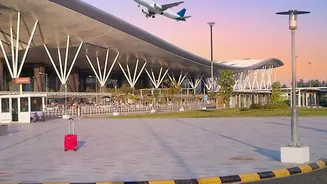








An Ambitious Expansion Plan
India is embarking on one of the world's most ambitious aviation expansions. The government has announced plans to develop 100 new airports over the next decade, building on the significant growth that has already seen the country's airport network expand
from 74 in 2014 to 166 today. This next phase, backed by an investment of approximately ₹30,000 crore, is a core component of the Modified UDAN (Ude Desh ka Aam Nagrik) scheme. Approved in March 2026, the scheme extends for a ten-year period with the goal of making air travel more accessible and connecting parts of the country that have remained underserved.
Connecting the Unconnected
The primary focus of this expansion is not on the bustling metros, but on Tier-2 and Tier-3 cities, remote regions, and island territories. For years, air travel in India was concentrated around a few major hubs. The UDAN scheme was designed to change this by making regional routes financially viable for airlines through subsidies and incentives. The new plan doubles down on this strategy, aiming to activate unserved airstrips and build greenfield airports in places like the Himalayan regions and the islands of Lakshadweep and Andaman. The goal is to respond to a growing demand for connectivity coming from communities who want the economic and social opportunities that air travel brings.
The Economic Ripple Effect
New airports act as powerful economic engines. Improved connectivity does more than just move people; it stimulates trade, tourism, and investment. For businesses, especially in sectors like logistics, manufacturing, and IT, direct air access to smaller cities opens up new markets and talent pools. This is already visible in cities like Coimbatore, which has seen a boom in its international freight volumes since its airport was upgraded. Similarly, the development of new airports is having a significant impact on real estate, driving up land values and spurring residential and commercial development in surrounding areas long before the first flight takes off.
More Than Just Landing Strips
Building an airport is only the first step. To truly reshape connectivity, these new hubs must be integrated into a seamless national and international network. The government is also promoting a 'hub-and-spoke' model to address this. This system allows passengers from smaller 'spoke' airports to check in for their entire journey, including international legs, and transfer smoothly through larger 'hub' airports like Delhi. Ahmedabad recently became the third city to join this framework after Varanasi and Amritsar, a move intended to make global travel easier for people outside of India's biggest metro areas.
Challenges on the Horizon
Despite the ambitious plans, the path forward is not without challenges. The Indian aviation sector has historically faced issues like high operational costs, particularly for aviation turbine fuel, and a shortage of skilled manpower. Furthermore, ensuring the long-term viability of new routes is a significant hurdle. A 2023 audit of the UDAN scheme revealed that many routes awarded in earlier phases were not sustainable after the initial subsidy period ended. This highlights the critical need to ensure that the new infrastructure is supported by consistent passenger demand and airline operations, turning a 'ghost airport' into a thriving gateway.