
India's Most Ambitious Space Mission
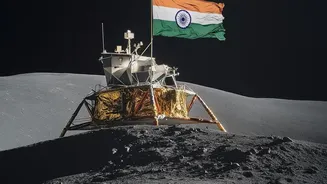
Following the success of Chandrayaan-3, the Indian Space Research Organisation (ISRO) is undertaking its most complex and ambitious project to date: the Chandrayaan-4 lunar sample-return mission. The primary objective is to soft-land on the Moon, collect
up to three kilograms of lunar soil and rock, and, for the first time in India's history, return these precious samples safely to Earth for scientific analysis. This mission is a significant technological leap, aiming to make India only the fourth country in the world to accomplish this feat, after the United States, the former Soviet Union, and China. Approved by the Union Cabinet with a substantial budget, the mission is a cornerstone of India's long-term space exploration goals, including a potential crewed lunar landing by 2040.
A Symphony of Five Modules
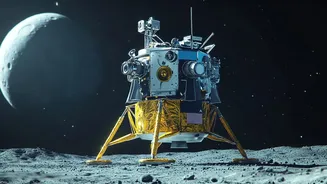
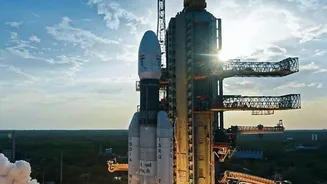
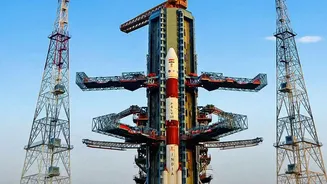
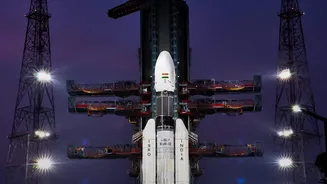
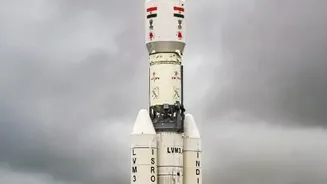
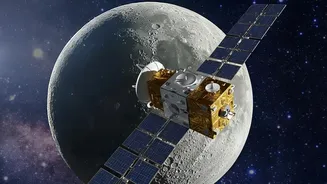
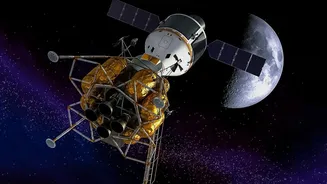
The sheer complexity of a round-trip journey to the Moon requires a sophisticated, multi-part spacecraft. Chandrayaan-4 is composed of five distinct modules, each with a critical role to play in the mission's success. These are the Propulsion Module, the Descender Module (the lander), the Ascender Module, the Transfer Module, and the Re-entry Module. The total weight of this integrated system is so great—around 9,200 kg—that ISRO's powerful LVM3 rocket cannot carry it in a single trip. The solution is an innovative dual-launch strategy. Two separate LVM3 rockets will be used to send the modules into Earth's orbit in two stacks. One stack will contain the Descender and Ascender modules, while the other will carry the Propulsion, Transfer, and Re-entry modules.
The Orbital Ballet and Lunar Landing
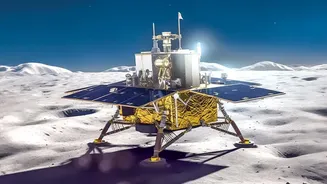
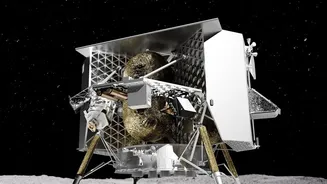
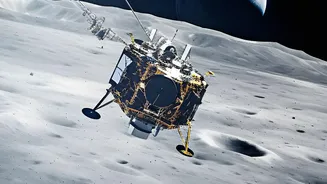
Once in Earth's orbit, the two stacks will perform a crucial and delicate manoeuvre: autonomous rendezvous and docking. This will be a first for an Indian deep space mission. Once docked into a single integrated spacecraft, the Propulsion Module will fire its engines to set a course for the Moon. Upon reaching lunar orbit, the Descender Module, carrying the Ascender on its back, will separate and begin its powered descent to a predetermined site near the Moon's south pole. After a safe and soft landing, a robotic arm on the lander will get to work. It will scoop surface soil and use a drill to collect subsurface samples, which are then transferred into a sealed container aboard the Ascender Module.
The Journey Home
With the lunar samples secured, the most novel phases of the mission begin. The Ascender Module will ignite its engines, using the Descender as a launchpad to lift off from the lunar surface and return to orbit—another major first for ISRO. In lunar orbit, it will perform a second rendezvous and docking with the waiting Transfer Module. The sample container is then automatically transferred to the Re-entry Module. Once the transfer is complete, the Transfer Module will fire its engine for the trans-Earth injection burn, sending the Re-entry Module on its way back home. The final, fiery phase involves the Re-entry Module separating and plunging through Earth's atmosphere, protected by its heat shield, before deploying parachutes for a safe landing on Indian soil.
More Than Just Moon Rocks
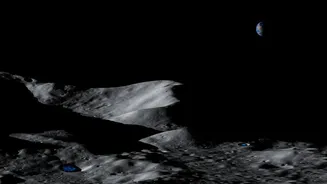
The scientific value of returning pristine lunar samples, especially from the geologically rich and potentially water-ice-bearing south pole, is immense. It allows scientists to use state-of-the-art equipment on Earth to conduct analyses far beyond the capabilities of robotic instruments on the Moon, potentially unlocking secrets about the origin of the Earth-Moon system and the distribution of resources like water. Beyond the science, Chandrayaan-4 is a crucial technology demonstrator. Mastering complex operations like orbital docking, launching from another celestial body, and high-speed atmospheric re-entry are essential capabilities that pave the way for India's future ambitions, including the Bharatiya Antariksh Station (Indian Space Station) and human spaceflight. This mission is not just about bringing a piece of the Moon to India, but about taking India's space program to the next level.