




A New Look at a Cosmic Neighbour
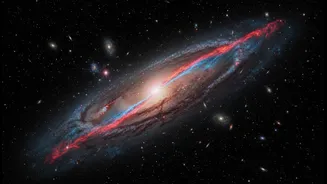
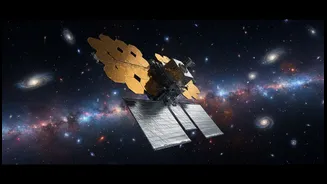
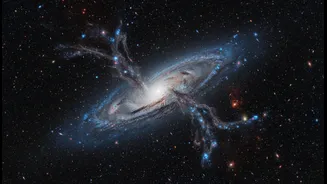
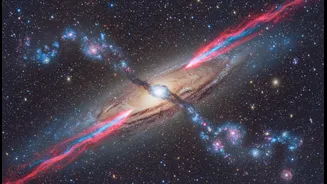
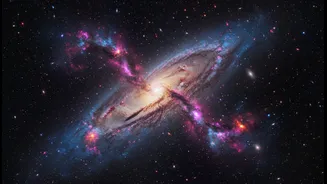
The James Webb Space Telescope (JWST) has once again delivered a stunning view of the cosmos, this time focused on Centaurus A. Located about 13 million light-years away, it's one of the closest radio galaxies to Earth. While previous telescopes like
Hubble have studied it, Webb's powerful infrared instruments pierce through obscuring cosmic dust to reveal the galaxy's heart in unprecedented detail. The new images, released to celebrate Webb's fourth year of science, showcase intricate, glowing filaments of dust and gas, the remnants of a galactic collision that happened billions of years ago. For the first time, astronomers can see millions of individual stars, offering a chance to perform 'galactic archaeology' and reconstruct the galaxy's chaotic history.
The Engine at the Galaxy's Heart
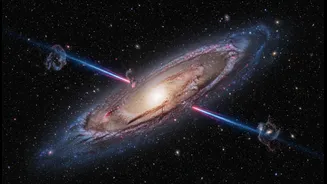
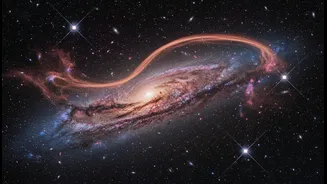
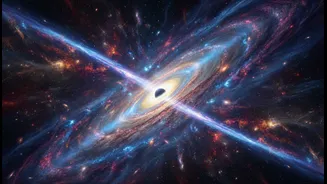
At the centre of Centaurus A lies a supermassive black hole, about 55 million times the mass of our sun. This black hole is an active galactic nucleus (AGN), meaning it's actively feeding on surrounding gas and dust. This cosmic feast is messy. As material swirls into the black hole, it unleashes colossal jets of high-energy particles that travel at nearly half the speed of light, stretching over a million light-years into space. These jets are essentially natural particle accelerators, and studying them provides a unique laboratory for understanding extreme physics—processes that are impossible to replicate on Earth. The new Webb image offers a clearer view of the interplay between this powerful engine and the surrounding galaxy, showing how the black hole's activity shapes the entire system.
From Deep Space to Your Device
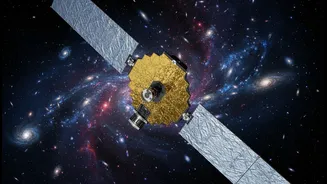
Here is where this celestial spectacle connects to your daily life. The technologies that underpin modern planning—from Google Maps routing your commute to weather apps predicting a weekend storm—rely heavily on a network of satellites. The Global Positioning System (GPS), in particular, is fundamental. These satellites, however, are constantly bombarded by high-energy particles and radiation from space, some of which originate from powerful cosmic sources like the jets seen in Centaurus A. This 'space weather' can interfere with satellite signals, introducing errors that can throw off GPS locations and disrupt communications. While Centaurus A itself isn't a direct threat, understanding the physics of its jets helps scientists build better models for the cosmic radiation environment that all our satellites must navigate.
Refining Our Digital Foundation
The principles of astrophysics are crucial for making GPS work accurately. To calculate your position, GPS receivers must measure tiny differences in the arrival time of signals from multiple satellites. These calculations must account for Einstein's theories of relativity and the very space environment the signals travel through. By studying extreme environments like Centaurus A, astrophysicists can refine their understanding of how energetic particles are created and how they propagate through space. This fundamental knowledge feeds into more sophisticated models of space weather. In turn, these models allow engineers to design more resilient satellites and develop better error-correction algorithms, ensuring the GPS in your car or phone remains reliable even during periods of high solar or cosmic activity.
The Future of Precision
The insights gained from Webb's new image are not just about improving current technology; they're about building the foundation for the next generation. A more precise understanding of the universe's most powerful phenomena can lead to more robust communication networks, safer air travel through better atmospheric monitoring, and even advancements in fields like materials science and medical imaging, which have historically benefited from astronomical innovations. The journey from a stunning picture of a distant galaxy to a more reliable map on your phone is a long one, built on decades of scientific curiosity. Each new detail Webb uncovers, even from millions of light-years away, adds a small but crucial piece to the puzzle, strengthening the invisible technological scaffolding that supports our modern world.