
A Groundbreaking Technological Feat
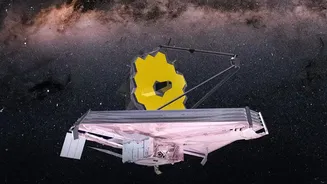
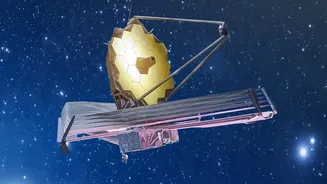
The James Webb Space Telescope represents a multi-billion dollar investment in humanity's quest to understand the cosmos. As the successor to the Hubble Space Telescope, its power lies in its enormous mirror and its focus on infrared light. This allows
it to peer through cosmic dust and see the faint heat signatures of the universe's oldest stars and most distant planets. Its suite of advanced instruments, including powerful spectrographs, are designed to do something truly remarkable: analyze the chemical makeup of atmospheres hundreds or even thousands of light-years away. These tools are now delivering on their promise, providing a level of detail that was previously unimaginable and opening a new chapter in exoplanet exploration.
How to Map an Alien Atmosphere
So how exactly does the JWST 'map' a sky it can't technically see like a picture? The process relies on a technique called transit spectroscopy. When an exoplanet passes in front of its host star from our perspective, a tiny fraction of the starlight filters through the planet's atmosphere. Different chemical elements and molecules absorb light at very specific wavelengths. Water, for example, leaves a distinct 'signature' in the infrared spectrum. By capturing this light and breaking it down, scientists can identify the molecules present. To create a 'map', the telescope observes the planet through its entire orbit, including when it passes behind its star. By measuring the changes in light during these phases, scientists can deduce temperature variations and the distribution of molecules across the planet's atmosphere, distinguishing between its hotter dayside and cooler nightside.
WASP-18 b: A World of Extremes
One of the most stunning examples of this technology in action comes from studies of WASP-18 b, an ultra-hot gas giant about ten times more massive than Jupiter, located 400 light-years away. The JWST didn't just find the signature of water vapor in its atmosphere; it created a detailed temperature map. This revealed a dramatic temperature difference of up to 1,000 degrees from the side permanently facing its star to the 'terminator' line where day meets night. The detection of water on such a scorching world—where molecules are expected to be torn apart—is a testament to the telescope's incredible sensitivity. This ability to map temperature and chemical distribution provides crucial clues about atmospheric circulation and planetary weather on worlds completely unlike our own.
From Detection to Understanding
For decades, simply detecting the presence of key molecules like water was the primary goal. The Hubble Space Telescope first definitively found water in an exoplanet's atmosphere in 2013, a landmark achievement at the time. However, the JWST is pushing the science from simple detection to detailed characterization. Knowing that water exists is one thing; knowing where it is concentrated, how it moves, and how its presence relates to the planet's temperature and climate is another entirely. This new capability allows scientists to test theories on planetary formation and evolution. For instance, observations of some sub-Neptune planets have challenged expectations, revealing atmospheres with surprising compositions that force a rethink of how these common worlds form.