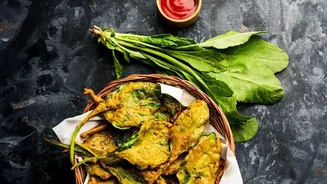

The Golden Rule: Get the Batter Consistency Right
The single most important hack for successful air-fryer pakoras is a thick batter. Unlike deep frying, where hot oil instantly sets a thinner batter, an air fryer's circulating heat requires a sticky, dough-like consistency. If your batter is too runny,
it will drip through the basket, creating a mess and leaving you with flat, unevenly cooked fritters. Start by mixing your besan (gram flour) and spices with the chopped vegetables first, allowing the moisture from the veggies to hydrate the flour. Then, add water one tablespoon at a time until the batter just clings to the vegetables without pooling at the bottom of the bowl.
Preheat for Maximum Crispiness
Do not skip the preheating step. Placing your pakoras into a hot air fryer basket is crucial for creating that initial sizzle and a crispy outer layer. Think of it as the equivalent of dropping batter into hot oil. Preheating for about five minutes at your target temperature, typically around 190-200°C, ensures the cooking process starts immediately, preventing the pakoras from steaming and becoming soggy. This simple step is a game-changer for achieving a satisfying crunch.
A Little Oil Goes a Long Way
While the goal is to cut oil, 'oil-free' is not the path to crispy pakoras. The key is to use a minimal amount strategically. Adding about a teaspoon of oil to your batter helps keep the inside of the pakora soft and moist. More importantly, lightly brushing or spraying the tops of your pakoras before they go into the air fryer is what helps the besan turn a beautiful golden-brown and develop that fried texture. This tiny amount of oil—often just a teaspoon for an entire batch—is what bridges the gap between a dry, baked texture and a satisfyingly crisp one.
Don’t Crowd the Basket
An air fryer works by circulating superheated air around the food. For this to work effectively, the air needs space to move. Placing pakoras in a single, even layer with space between each piece is non-negotiable. Overcrowding the basket traps steam, which will make your pakoras soggy instead of crispy. It’s always better to cook in two smaller batches than one large, crowded one. This ensures every pakora is blasted with hot air from all sides, resulting in an even, crunchy finish.
The Mid-Cook Shake and Flip
To ensure uniform browning and crispiness, you need to intervene halfway through the cooking process. After about 6-7 minutes of cooking, pause the air fryer, pull out the basket, and give the pakoras a good shake or flip them individually. Some experts even recommend giving them another very light spray of oil on the newly exposed side to enhance crisping. This step is crucial for cooking the undersides and achieving that all-over golden crunch.
How Much Oil Do You Really Save?
The term “significantly” is not an exaggeration. Traditional deep-frying requires submerging the pakoras in at least 2-4 cups of oil. A significant portion of this oil is absorbed by the batter. In contrast, an entire batch of air-fried pakoras can be made with as little as one or two teaspoons of oil—one mixed into the batter and another for brushing on top. Studies comparing cooking methods show that air-frying can reduce fat content by 70-80% compared to deep-frying, without a massive compromise on texture if done correctly. One source notes that while traditional pakoras can have 400-700 calories per serving, their air-fried version had just 39 calories.