




What is the Dragonfly Mission?
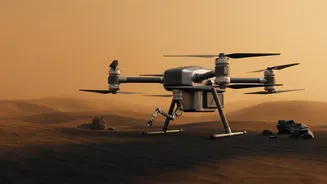
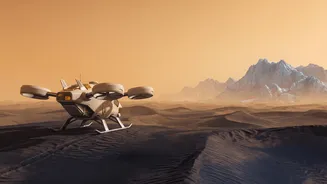
Dragonfly is a car-sized, nuclear-powered, dual-quadcopter drone designed to fly across the surface of Titan. Scheduled for launch in July 2028, it will embark on a long journey, arriving at the mysterious moon in 2034. Unlike stationary landers or slow-moving
rovers, Dragonfly will be able to fly from one location to another, covering tens of miles in a single trip. This mobility is key to its mission, allowing scientists to sample diverse geological settings across the moon's surface, from organic sand dunes to the floor of an impact crater where liquid water may have once mixed with complex organic materials. It will be the first powered aircraft to fly on another world with a significant atmosphere, taking advantage of Titan’s low gravity and thick, nitrogen-rich air, which is four times denser than Earth's.
Goal 1: Searching for the Building Blocks of Life
The primary goal of the Dragonfly mission is astrobiology. Titan is a prime target for studying prebiotic chemistry—the chemical steps that occurred on Earth before life began. Its surface is covered in a vast array of complex organic compounds, which have formed as sunlight breaks down the methane in its atmosphere. Scientists believe Titan offers a natural laboratory to see how far this chemistry can progress. Dragonfly's instruments, particularly its mass spectrometer (DraMS), will analyze surface samples to hunt for chemical biosignatures and investigate the habitability of Titan's environment. The mission aims to understand if the ingredients for life have developed on this alien moon, which could offer profound insights into the origin of life itself.
Goal 2: Understanding a World of Methane
Titan is the only other body in our solar system with a liquid cycle similar to Earth's water cycle. However, on Titan, the liquid is not water but hydrocarbons like methane and ethane. These compounds form clouds, rain down, carve river channels, and fill vast lakes and seas. Dragonfly will study this active methane cycle, providing unprecedented ground-level data. Its meteorology sensors (DraGMet) will measure temperature, pressure, wind, and other atmospheric conditions. By visiting different locations, including the landing site in the Ahmakiq Undae dune fields near Selk crater, the mission will provide a detailed picture of Titan's Earth-like, yet distinctly alien, climate and surface processes.
Challenge: A Long, Cold Journey and a Frigid Destination
The mission faces monumental challenges, beginning with a six-and-a-half-year voyage to the outer solar system. Upon arrival, the spacecraft must survive a two-hour descent through Titan's dense atmosphere, a far longer and more complex entry than the 'seven minutes of terror' for Mars landers. Once on the surface, Dragonfly must operate in extreme cold, with temperatures plummeting to around minus 179 degrees Celsius. This requires the spacecraft to be incredibly well-insulated. Ironically, a key challenge is preventing the lander from overheating. Its nuclear power source, a Multi-Mission Radioisotope Thermoelectric Generator (MMRTG), produces significant heat, which must be carefully managed to keep the instruments operational without cooking them.
Challenge: Autonomous Flight in an Alien Sky
Due to the vast distance, the round-trip communication time between Earth and Titan can be up to 2.5 hours, making real-time piloting impossible. Dragonfly must therefore fly autonomously, making its own decisions about navigation and landing. While Titan’s thick atmosphere and low gravity are ideal for flight, the environment is not without risk. The rotorcraft will need to scout landing zones with its cameras, analyze terrain, and execute landings safely without human intervention. Engineers have had to account for everything from unsteady air pressure interactions between the rotors to the risk of kicking up debris during takeoff and landing. Each flight will last about half an hour, after which the vehicle will land to recharge its batteries, a process that takes one Titan day (16 Earth days), and analyze samples with its drill and onboard laboratory.