


The Black Hole Family Mystery
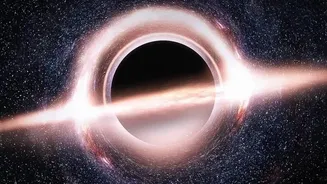
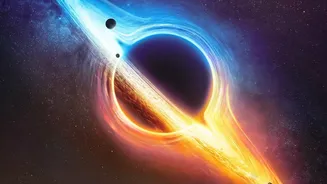
For a long time, black holes seemed to come in only two sizes: small and extra-large. First, you have stellar-mass black holes, with masses up to about 100 times that of our sun. They form when a massive star collapses at the end of its life. On the other
end of the spectrum are the supermassive black holes that lurk at the centers of most large galaxies, including our own Milky Way. These are monsters, weighing millions or even billions of times the sun's mass. But this picture left a huge, puzzling gap. Where were the 'intermediate-mass' black holes (IMBHs), those with masses between 100 and 100,000 times that of the sun? For astrophysicists, their apparent absence was a major headache, as they are a crucial missing link in cosmic evolution.
The Elusive Middle Child
IMBHs are theoretically critical because they could be the 'seeds' from which supermassive black holes grow. The leading idea is that these cosmic giants didn't just appear fully formed; they grew over billions of years, either by constantly consuming gas and stars or by merging with other black holes. A logical pathway would be for stellar-mass black holes to merge, forming IMBHs, which then continue to merge and grow into the supermassive category. This process is called hierarchical merger. The problem was, finding direct proof of an IMBH was incredibly difficult. They are too massive to form from a single star but their environments lack the extreme conditions found at galactic centers where supermassive ones are born. They were the universe's elusive middle children, often talked about but rarely seen.
Hearing the Universe Rumble
The game changed with the advent of gravitational wave astronomy. Instead of looking for light, observatories like LIGO and Virgo 'listen' for gravitational waves — ripples in the very fabric of spacetime. These waves are created by the most violent events in the cosmos, such as the collision of two black holes. As these massive objects spiral into each other and merge, they send out a powerful burst of gravitational waves, like a cosmic thunderclap. These signals are incredibly faint by the time they reach Earth, but highly sensitive detectors can pick them up. By analyzing the unique 'fingerprint' of the wave, scientists can determine the masses of the merging objects and the final product. This gave science a brand-new tool to hunt for IMBHs.
A Groundbreaking 'Chirp'
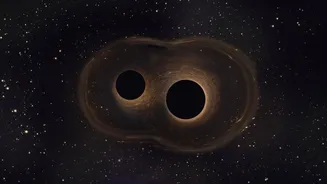
The breakthrough came on May 21, 2019. The LIGO and Virgo detectors picked up a signal, lasting just a tenth of a second, from an event named GW190521. It was the result of two black holes, with masses of about 85 and 66 times that of the sun, colliding. The larger of the two was already a puzzle, as it fell within a 'mass gap' where black holes were not thought to form directly from stars. But the most stunning part was the result of the merger: a single black hole weighing about 142 solar masses. For the first time, scientists had captured the unambiguous birth of an intermediate-mass black hole. The event was a spectacular confirmation of theory, radiating away the energy equivalent of eight suns in the form of gravitational waves.
What This Tells Us Today
The detection of GW190521 and subsequent candidates has profound implications. It provides the first direct, observational evidence that IMBHs exist and that they can be formed through the merger of smaller black holes. This strongly supports the hierarchical merger model — the idea that black holes grow progressively larger through collisions. It helps explain how the universe could have built its supermassive black holes in the relatively short time since the Big Bang. Each detection of a merging IMBH is another piece of the puzzle, showing us the primary mechanism for black hole growth in action. It’s like finally finding the crucial adolescent stage in a species' life cycle, connecting the babies to the full-grown adults.