


A Watery Signal from the Void
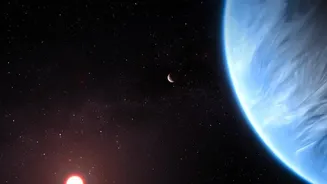
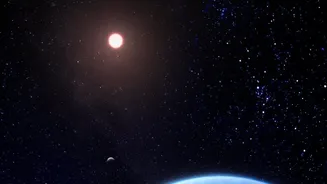
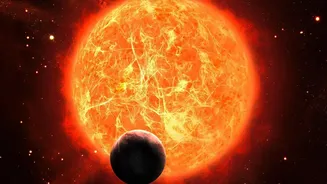
In a historic announcement for the global scientific community, astronomers confirmed the detection of a significant amount of water vapour in the atmosphere of a 'super-Earth' exoplanet. The planet, located dozens of light-years away, is a world larger
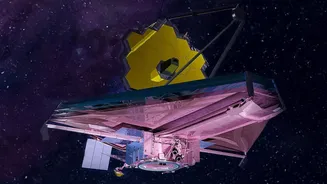
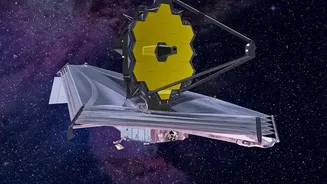
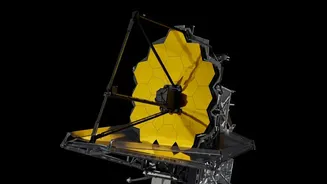
and more massive than our own but believed to be primarily rocky. This finding represents one of the most significant steps forward in the search for potentially habitable worlds beyond our solar system. The discovery was made by an international team of researchers using data from the JWST, a joint mission of NASA, the European Space Agency (ESA), and the Canadian Space Agency (CSA). While water has been detected on gas giants before, finding it enveloping a rocky planet situated within its star's 'habitable zone'—the orbital region where temperatures could allow for liquid water—is a long-sought milestone. It transforms the planet from a point of light into a place with a tangible environment that we can begin to study and understand.
How Webb Uncovered the Secret
The James Webb Space Telescope did not 'see' the water directly. Instead, it used a technique called transmission spectroscopy to taste the planet's atmosphere. As the exoplanet passed in front of its host star from our perspective, a tiny fraction of the starlight filtered through the planet's atmospheric layer. JWST's highly sensitive infrared instruments, particularly its Near-Infrared Spectrograph (NIRSpec), captured this light. Molecules in an atmosphere absorb specific wavelengths, or colours, of light. Water vapour has a very distinct absorption signature in the infrared spectrum. When scientists analysed the light that had passed through the atmosphere, they found the tell-tale 'dips' in the spectrum that correspond precisely to water. This chemical fingerprint provided clear and compelling evidence that a water-rich atmosphere surrounds this distant world, a feat of observation that was impossible before the power of Webb.
What Is a Super-Earth?
The term 'super-Earth' refers not to a planet's habitability, but to its size and mass. These are exoplanets with a mass higher than Earth's but significantly lower than that of our solar system's ice giants, like Neptune or Uranus. Typically, they are up to 10 times Earth's mass and have a radius larger than Earth's but smaller than Neptune's. Super-Earths are one of the most common types of planets discovered in our galaxy, yet intriguingly, our own solar system does not have one. This makes them a major focus for astronomers. Depending on their composition and distance from their star, they could be searing hot lava worlds, icy globes, or something in between. A rocky super-Earth with an atmosphere and the right temperature, however, is a prime candidate for holding liquid water and, just possibly, hosting life.
A Milestone, Not a Guarantee
The presence of water vapour is an incredibly exciting development, but scientists are quick to manage expectations. Finding water in gaseous form is not the same as finding liquid water oceans. The planet's surface temperature, atmospheric pressure, and composition are all critical factors that determine whether water can exist as a liquid on the surface. Furthermore, researchers are now undertaking rigorous follow-up observations to rule out any other possibilities. In some cases, features that appear to be from a planet's atmosphere can actually be caused by cool spots on the star itself. Despite these necessary cautions, the discovery marks a pivotal shift from simply finding rocky planets to being able to characterize their atmospheres. It proves that the tools are in place to identify the key ingredients for life, even across interstellar distances.