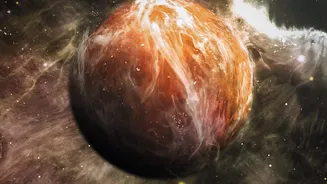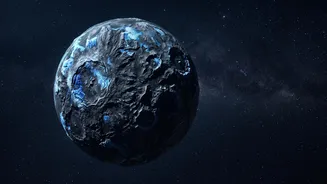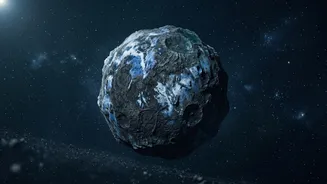



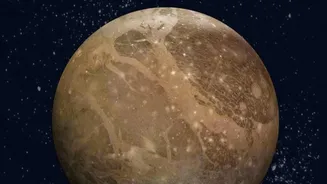
In the cold, dark expanse beyond Pluto, astronomers have spotted a new celestial wanderer. Designated 2026 ED138, this distant object is now at the centre of a scientific debate: is it the solar system’s newest dwarf planet?
A New Object in the Kuiper Belt
Scientists at the Vera C. Rubin
Observatory recently announced the discovery of 2026 ED138, a trans-Neptunian object, meaning it orbits the sun from beyond Neptune. This region, known as the Kuiper Belt, is a vast, icy debris field left over from the formation of the solar system. What makes 2026 ED138 special is its size and brightness. Preliminary estimates place its diameter somewhere between 600 and 1,500 kilometres. For context, Pluto, the most famous dwarf planet, has a diameter of about 2,370 kilometres. The new object was found in a crowded field of stars near the plane of the Milky Way, which is likely why it remained hidden for so long. Its discovery has ignited a fascinating process of verification to see if it qualifies for one of the most exclusive clubs in our solar system.
The Dwarf Planet Checklist
So, what does it take to become a dwarf planet? According to the International Astronomical Union (IAU), the official record-keepers of celestial objects, a body must meet specific criteria. First, it must orbit the Sun, which 2026 ED138 clearly does. Second, it must not be a moon, or a satellite of another planet. Third, and this is a crucial test, it must have enough mass for its own gravity to pull it into a nearly round shape. This state is known as hydrostatic equilibrium, where the inward pull of gravity is balanced by the outward push of its internal pressure. This is the point where an object stops being an irregular, potato-shaped asteroid and becomes a sphere. But there's one more hurdle, and it's the one that famously demoted Pluto.
The 'Clearing the Neighbourhood' Problem
The final criterion is that the object has 'cleared the neighbourhood' around its orbit. This means it has become the gravitationally dominant object in its orbital path, having either absorbed or flung away other smaller objects over billions of years. The eight planets, from Mercury to Neptune, have all accomplished this. Earth, for example, is 1.7 million times more massive than all the other debris in its orbital zone combined. Dwarf planets, however, fail this test. Pluto shares its orbit with countless other icy bodies in the Kuiper Belt, and its mass is only a fraction of the total mass of its neighbours. Since 2026 ED138 was also found in this crowded region, it almost certainly has not cleared its neighbourhood, making 'dwarf planet' its highest possible classification.
The Quest for a Round Shape
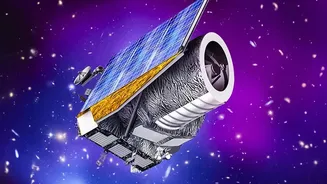
The key question for 2026 ED138 now boils down to its shape. Is it massive enough to have achieved hydrostatic equilibrium? Determining this from billions of kilometres away is a significant challenge. Scientists start by measuring an object's brightness. However, brightness can be misleading; a small, highly reflective object can appear as bright as a large, dark one. To solve this, astronomers need more observations, particularly using infrared telescopes. These instruments can help determine an object's size and surface properties more accurately. By combining data on its size, estimated mass, and composition (whether it's mostly ice or rock), scientists can model whether its gravitational force is strong enough to have pulled it into a sphere. This is why more observations are crucial before a final verdict can be reached.
A Growing Family of Worlds
Currently, the IAU officially recognizes only five dwarf planets: Ceres (in the asteroid belt), and four in the outer solar system—Pluto, Haumea, Makemake, and Eris. If confirmed, 2026 ED138 could become the sixth member of this exclusive family and potentially one of the largest discovered beyond Neptune. The discovery is a testament to the power of new instruments like the Rubin Observatory, which is designed to scan the sky repeatedly and detect faint, moving objects that were previously missed. Astronomers believe there may be hundreds more dwarf planets waiting to be found in the Kuiper Belt. Each new discovery provides another piece of the puzzle, helping us understand the formation and evolution of our cosmic neighbourhood.