






The HIIT Workout Hiding in Plain Sight
High-Intensity Interval Training (HIIT) is a popular fitness strategy known for its efficiency. It involves short, intense bursts of all-out effort followed by brief recovery periods. This method elevates your heart rate quickly, helping to improve cardiovascular
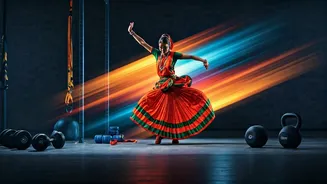
health and burn calories effectively in a shorter amount of time. While many associate HIIT with sprints, burpees, and kettlebell swings, India’s rich tapestry of regional folk dances offers a vibrant, music-driven alternative. Many of these traditional dances are naturally structured like a HIIT session. They feature explosive, high-energy movements followed by moments of slower, more graceful steps that act as active recovery. By embracing these dances, you’re not just exercising; you’re participating in a centuries-old cultural tradition while getting a fantastic, full-body workout. It’s time to ditch the monotonous gym routine and dance your way to fitness.
Bhangra: The Power-Packed Punjabi Workout
Originating from the Majha region of Punjab, Bhangra is arguably the most famous high-energy Indian folk dance. Traditionally performed to celebrate the harvest, its movements are explosive and demand immense stamina. Characterised by powerful leg and arm movements, high jumps, deep squats, and continuous shoulder shrugs (the iconic 'jhoomar' step), Bhangra is a phenomenal anaerobic exercise.
To turn it into a HIIT session, focus on a 'dhol' beat. Start with high-energy moves like jumping on the spot while kicking your legs out for 45 seconds. Push your intensity to the maximum. Follow this with 15 seconds of a slower, marching Bhangra step, allowing for active recovery. A typical Bhangra routine will naturally target your quads, glutes, shoulders, and core, making it a comprehensive workout that feels more like a celebration than exercise.
Garba: The Energetic Gujarati Cardio Circle
Performed during Navratri, Gujarat’s Garba is a graceful yet demanding dance that can be easily ramped up for a high-intensity workout. The traditional format involves dancing in a circle with a series of claps, twirls, and side-to-side movements. While it can be low-impact, increasing the speed and adding deeper squats turns it into a serious calorie-burner.
For a Garba HIIT routine, pick a fast-tempo song. For 60 seconds, perform quick, wide-stepped movements in a circle, incorporating deep squats with every turn and clapping forcefully to engage your upper body. Then, for 20 seconds, slow down to a simple two-step, maintaining movement but lowering the intensity. This constant motion, combined with the core strength required for the spins and the leg power for the squats, makes Garba an excellent endurance-building and heart-pumping activity.
Bihu: The Brisk Rhythms of Assam
The Bihu dance from Assam is a joyous expression of cultural identity, performed during the Rongali Bihu festival. Its defining features are brisk, rhythmic footwork, rapid hand movements, and swaying hips. The dance requires agility, coordination, and a great deal of energy, making it a perfect candidate for a HIIT workout.
To structure a Bihu session, focus on the quick-step patterns. For 45 seconds, perform the characteristic fast foot-tapping while keeping your upper body engaged with swift hand gestures and hip movements. The pace should be fast enough to leave you breathless. Follow this with a 15-second recovery period of slow, side-to-side swaying, mimicking the gentler parts of the dance. This routine is fantastic for improving agility and stamina, and it heavily engages the core and lower body without the high-impact stress of jumping.
Lavani: The Dynamic Dance of Maharashtra
Lavani, a traditional dance form from Maharashtra, is known for its powerful rhythm and expressive movements. Performed to the beats of the 'dholki', it combines intricate footwork, quick spins, and dramatic pauses. The sheer speed and energy of Lavani make it a high-intensity activity that builds lower body strength and cardiovascular endurance.
Create a Lavani HIIT workout by focusing on the fast-paced segments. For 60 seconds, engage in rapid, powerful foot-tapping and energetic spins, keeping pace with the dholki’s quickest beats. The constant motion and requirement to stay on the balls of your feet provides a serious calf and quad workout. Follow this with a 20-second 'active rest' period, holding a graceful pose or performing a slow, expressive movement. This combination of explosive energy and controlled grace makes Lavani not just a workout, but a powerful performance.