




A Gravitational Tug-of-War
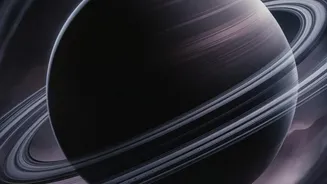
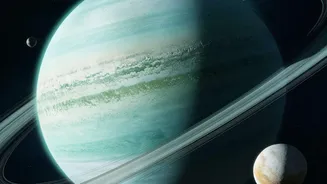
At its core, the relationship between rings and moons is governed by gravity. Planetary rings are not solid discs but are composed of billions of individual particles of ice and rock, each in its own orbit. Moons orbiting near or within these rings exert
a constant gravitational pull on these particles. This interaction is not chaotic; instead, it's a structured, cosmic dance. The gravitational influence of moons can sculpt the rings, creating sharp edges, waves, and intricate gaps that would otherwise blur over time. Data from missions like NASA's Cassini have shown just how active and dynamic these systems are.
Shepherd Moons: The Ring Keepers
One of the most fascinating examples of this interaction is the role of 'shepherd moons'. These are small moons that orbit near the edges of a ring or within gaps. Much like a shepherd guiding a flock, their gravity helps to contain the ring particles, preventing them from spreading out. For instance, a moon on the inner edge of a ring will speed up nearby particles, pushing them into a higher, more stable orbit within the ring. Conversely, a moon on the outer edge will slow particles down, causing them to fall into a lower orbit, again keeping the ring sharply defined. Saturn's F Ring, for example, is famously kept in its narrow ribbon-like shape by the shepherd moons Prometheus and Pandora.
When Moons Steal from the Rings
The exchange isn't just about shaping and sculpting; it's also about direct transfer of material. Moons embedded within the rings are constantly sweeping up particles of ice and dust. The Cassini spacecraft's close flybys revealed that several of Saturn's small, inner moons have a distinctive 'ravioli' or 'flying saucer' shape. This is because they have collected so much ring material around their equators that they've built up a prominent ridge or 'skirt'. This process, known as accretion, shows that the moons are actively growing by taking material directly from the ring system. The surfaces of these moons are also highly porous, suggesting they formed as ring material gradually settled onto a denser core.
When Moons Give Back
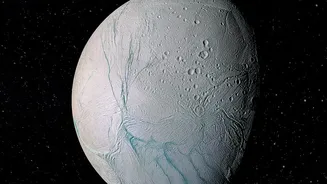
The exchange is a two-way street. Some moons don't just take; they also contribute material back into the system. The most dramatic example of this is Saturn's moon Enceladus. This small, icy world is geologically active, with huge plumes of water vapour and ice particles erupting from 'tiger stripe' fissures near its south pole. These geysers shoot material into space at incredible speeds. While some of this material falls back to Enceladus' surface as snow, much of it escapes to form Saturn's vast and diffuse E ring. In fact, scientists have confirmed that Enceladus is the primary source for the E ring, constantly replenishing it with fresh icy particles.
Ring Rain: A Final Destination
The ultimate fate for much of this ring material is to fall onto the parent planet itself in a phenomenon known as 'ring rain'. Saturn's powerful magnetic field and gravity pull charged particles from the inner rings down into the planet’s upper atmosphere. This inflow, which includes water and organic compounds, can be substantial, amounting to thousands of kilograms per second. This process not only affects the composition of Saturn's atmosphere but also means that the rings are not permanent. Scientists estimate that at the current rate of depletion, Saturn’s iconic rings could be gone within the next 100 to 300 million years—a relatively short time in cosmic terms.