







The Celestial Dance: Opposition and Conjunction
To understand when to see Saturn, it helps to know its two most important positions relative to Earth: opposition and conjunction. Opposition is the best time to view Saturn. It happens when Earth passes directly between the Sun and Saturn. During this
period, the planet is at its closest to us for the year, appearing bigger and brighter. It rises around sunset, stays visible all night long, and sets around sunrise. For 2026, Saturn's opposition occurs on October 4, making early October the prime viewing window. The opposite of opposition is conjunction. This is when Saturn is on the far side of the Sun from Earth. The Sun's glare makes it impossible to see. These two events are the main reason Saturn seems to appear and disappear from our night sky over the course of a year.
When and Where to Look in India
For observers in India, the weeks surrounding the October 4, 2026, opposition are ideal. On that night, Saturn is expected to rise in the eastern sky at approximately 6:11 PM IST. It will then travel across the sky, reaching its highest point around midnight (12:17 AM) before setting in the west at about 6:23 AM the next morning. You don't need to stay up all night; any clear evening during this period offers a great chance to see it. To the naked eye, Saturn will look like a bright, steady, yellowish point of light—unlike stars, it won't twinkle as much. It will be located in front of the constellation Cetus. While October 4 is the peak, Saturn will remain an excellent target for weeks before and after, easily visible through the end of 2026.
The Tilt of the Rings
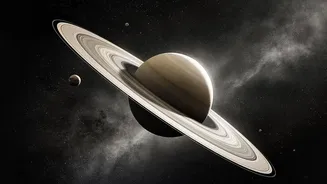
Another fascinating reason Saturn's appearance changes is the tilt of its famous rings. Just like Earth, Saturn is tilted on its axis. As it completes its nearly 30-year orbit around the Sun, our viewing angle of its rings changes. Roughly every 13 to 15 years, we see the rings edge-on, making them seem to disappear entirely when viewed with small telescopes. This last happened in March 2025. By October 2026, the rings will have started opening up again, tilted at about 7.5 degrees toward us. This makes them visible again, though they will still appear quite narrow compared to their maximum tilt, which we won't see again until around 2032.
Your Sky-Gazing Toolkit
You can spot Saturn without any equipment, but a few simple tools can greatly enhance the experience. Start with a good sky-charting app on your smartphone. Apps like SkyView, Star Walk 2, or Stellarium use your phone's location and sensors to show you exactly where to look when you point it at the sky. For a uniquely Indian perspective, the 'Bhagol: Indian Sky Map' app shows constellations and celestial bodies with their names from Indian astronomical traditions. To see the planet's rings, you'll need at least a good pair of binoculars or, ideally, a small telescope. A magnification of at least 25x is recommended to distinguish the rings from the planet itself.
Finding the Perfect Spot in India
Your location matters. The biggest obstacle for most people in India is light pollution from cities. To get the best view, find a location away from bright city lights. A park, a rooftop with an unobstructed view, or a trip to the outskirts of town can make a huge difference. You'll also want a clear view of the eastern horizon to catch Saturn as it rises after sunset. Weather is another key factor. October is generally a good month for sky-watching in many parts of India as the monsoon has ended, but be sure to check the forecast for a clear, cloudless night. Even a little haze can obscure the view, so patience is key.