






A World More Alive Than We Imagined
When NASA's New Horizons spacecraft flew past Pluto in 2015, it completely transformed our understanding of the dwarf planet. Scientists expected to find a mostly inert, heavily cratered ball of ice. Instead, the images sent back revealed a world with
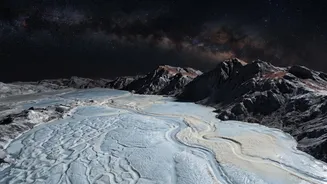
towering mountains of water ice, vast plains, and signs of ongoing geological processes. This discovery was shocking because small, cold worlds far from the sun were thought to have lost any internal heat needed to power such activity billions of years ago. Pluto's vibrant surface suggests it has found a way to stay geologically alive, providing a thrilling new puzzle for scientists and a new model for what's possible in the cold, dark corners of our solar system.
The Beating Heart of Pluto
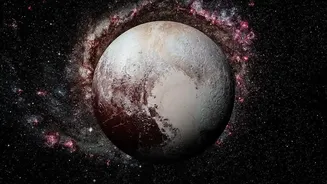
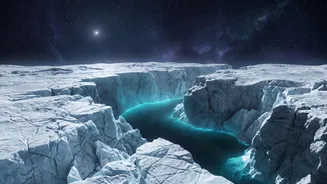
The most stunning feature on Pluto is a massive, heart-shaped basin of ice named Tombaugh Regio. The western half of this feature, a smooth plain called Sputnik Planitia, is the geological engine of the dwarf planet. This plain is filled with frozen nitrogen, methane, and carbon monoxide ices. Astonishingly, it has virtually no impact craters, suggesting its surface is incredibly young—less than 10 million years old and perhaps even younger. The surface is divided into large polygonal cells, which are evidence of slow, convective overturn, similar to the way wax moves in a lava lamp. This slow churning constantly renews the surface. This activity hints at a heat source from within Pluto, possibly from a subsurface ocean of liquid water that is still slowly freezing.
Volcanoes of Ice
Perhaps even more dramatic than its glaciers are Pluto's cryovolcanoes—volcanoes that erupt an icy, slushy mixture instead of molten rock. Several large mounds, some several kilometers high, have been identified as potential ice volcanoes. These features are unique in the solar system. Unlike volcanoes on Earth, they are thought to extrude a thick, toothpaste-like slurry of frozen water and other materials, building up massive domes over time. The existence of cryovolcanism is a major clue that Pluto retained more internal heat than scientists anticipated, allowing it to mobilize materials from its interior late in its history. This process helps explain how parts of the surface have been freshly paved over, erasing older features like craters.
A Blueprint for the Kuiper Belt
Pluto's complexity isn't just a local curiosity; it serves as a crucial reference point for countless other objects in the Kuiper Belt, the vast ring of icy bodies orbiting beyond Neptune. This region contains thousands of objects, including other dwarf planets like Eris, Makemake, and Haumea. Because these worlds are so distant, it's impossible to see their surfaces in detail. But by studying Pluto, scientists can infer what might be happening on them. For example, Neptune's large moon Triton, which is thought to be a captured Kuiper Belt object, shows landscapes that appear similar to Pluto's, including evidence of cryovolcanism. Pluto’s active geology, potential subsurface ocean, and complex atmosphere provide a model to test against these other worlds, suggesting they may not be the simple, inactive bodies once assumed.
From Demoted Planet to Rosetta Stone
The debate over Pluto's planethood in 2006 was sparked by the discovery of other large objects in its vicinity, suggesting it wasn't unique. Ironically, the New Horizons mission has shown that Pluto's true value lies not in being a planet, but in being the first of these icy worlds to be seen up close. It has become a kind of Rosetta Stone for the outer solar system. The processes shaping Pluto—from flowing nitrogen glaciers to the physics of its thin atmosphere—give scientists a ground-truth for interpreting the faint light received from other dwarf planets. By understanding the forces at play on Pluto, we can better estimate which other distant worlds might also harbor subsurface oceans, active geology, or even the basic conditions for habitability.