




A Telescope Built Differently
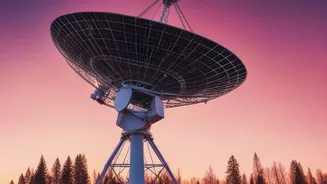
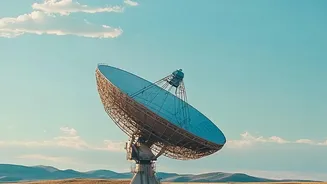
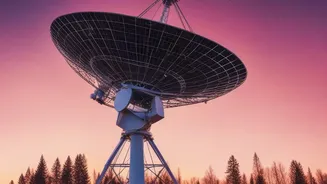
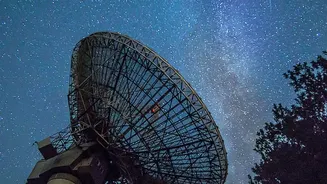
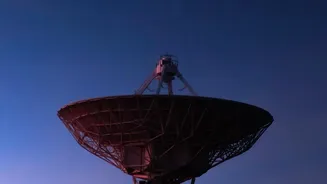
Deep in British Columbia, Canada, a strange-looking telescope points permanently at the sky. It has no moving parts and looks more like a set of four massive snowboarding half-pipes than a traditional observatory dish. This is the Canadian Hydrogen Intensity
Mapping Experiment, or CHIME. Its unique design allows it to stare at a huge swath of the sky at once, relying on the Earth's rotation to scan the cosmos. While it was originally built to map hydrogen over vast stretches of the universe, its incredible sensitivity and massive data processing power—sifting through information equivalent to a few percent of global internet traffic every second—have made it exceptionally good at two things: mapping the universe's expansion and detecting mysterious Fast Radio Bursts (FRBs).
The Puzzle of Cosmic Expansion
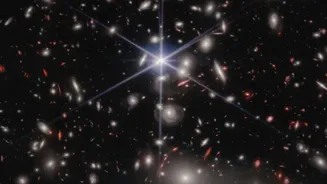
One of the biggest questions in physics is understanding dark energy, a mysterious force believed to be causing the universe to expand at an ever-accelerating rate. To study this, scientists need to create detailed 3D maps of the universe's history. The traditional way is to painstakingly find and measure individual galaxies, which is slow and costly. CHIME was designed for a different approach called 'intensity mapping'. Instead of finding individual galaxies, it measures the faint radio glow from the most common element in the universe: hydrogen gas. This acts as a cosmic tracer, revealing how matter is distributed across space and time.
A Breakthrough in Measurement
Recent findings from the CHIME collaboration mark a major milestone for this new technique. For the first time, the telescope has detected the large-scale structure of hydrogen gas from when the universe was about five billion years old, using only its own data. Previously, such results depended on cross-referencing with other galaxy surveys to confirm they were seeing a real signal. By developing new, sophisticated methods to filter out noise from human activity and closer astronomical objects, the CHIME team proved their method works independently. This achievement validates intensity mapping as a faster, less expensive, and powerful new way to map enormous volumes of the cosmos.
A Method, Not a Final Answer
This is where the headline becomes crucial. The recent CHIME publication does not claim to have solved the puzzle of dark energy. Instead, it presents a validated 'proof of concept' for a new tool that will be used to investigate it. As one researcher noted, the result doesn't yet say much about the expanding universe itself, but it plants a 'flag in the sand' showing that it will be possible to do so with this method. This is a common and vital step in science: before you can find the answer, you must first build and perfect the instrument that can take the measurement. CHIME has now shown its instrument works as designed, opening the door for future discoveries.
What This New Tool Unlocks
With this standalone detection method now proven, the real work begins. The CHIME team can now analyze its massive archive of data, which includes observations stretching back nearly seven years. By mapping hydrogen distribution at different points in cosmic history, they can track how the universe's expansion has changed over billions of years. This will provide an independent check on our understanding of dark energy and the fundamental laws of physics. Furthermore, the same technique can test models of how galaxies form and interact with the dark matter halos they live in. The achievement provides scientists with a completely new way to probe the cosmos, delivered by an instrument designed for exactly this purpose.